
Silicon (Si) Nanopowder for Battery Applications, Purity: 99.9%, Size: 100 nm

- SKU:
- NG04CO28095
- Shipping:
- Calculated at Checkout

Description
100 grams/435 €
Product Overview
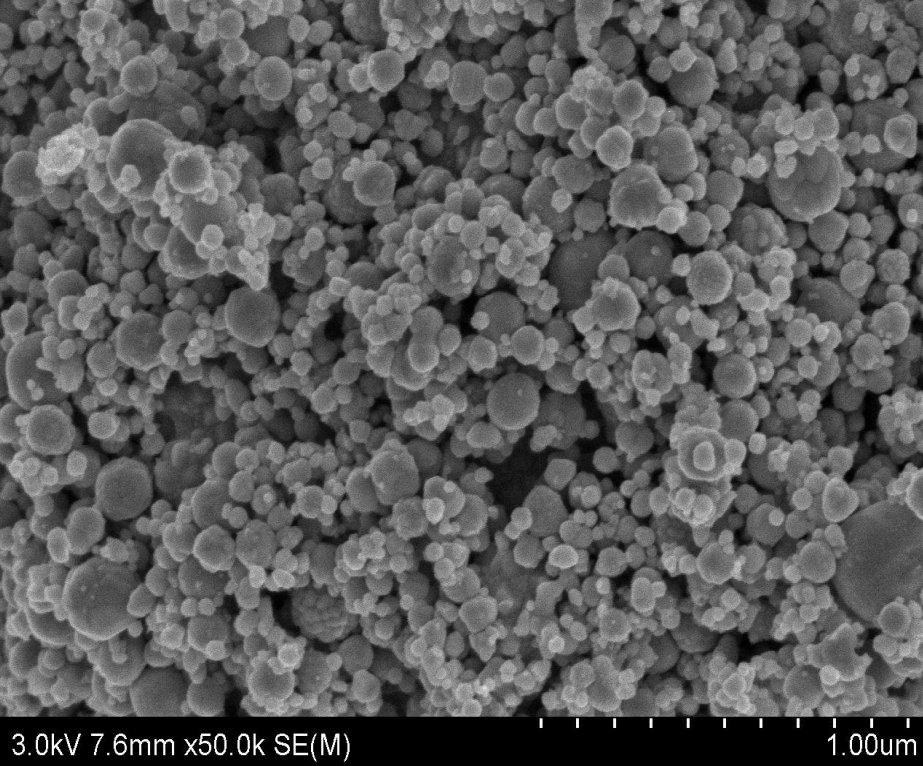
Silicon (Si) Nanopowder for Battery Applications is a high-purity nanomaterial engineered with particle size around 100 nm and optimized for electrochemical performance. Presented as a dark brown powder, it offers excellent structural uniformity and controlled elemental composition, ensuring stability and efficiency in demanding energy storage systems. Its nanoscale dimensions provide a large surface area and enhanced reactivity, making it particularly suitable for advanced battery technologies. Careful synthesis and characterization (SEM, XRD) confirm its quality and reliability for integration into next-generation energy solutions.
Technical Properties
| Purity | 99.9% | ||||||
| Average Particle Size | 100 nm | ||||||
| CAS No | 7440-21-3 | ||||||
| Elemental Analysis (ppm) | Zn | Fe | Cr | Mn | Cu | Mo | Al |
| ≤280 | ≤100 | ≤30 | ≤20 | ≤10 | ≤10 | ≤10 |
SEM Image
Applications
- Lithium-Ion Batteries: Used as an anode material to significantly increase energy density and cycle life compared to conventional graphite.
- Energy Storage Systems: Integrated into advanced rechargeable batteries for electric vehicles, portable electronics, and grid-scale storage solutions.
- Nanostructured Electrodes: Applied in the development of silicon-based nanowires, composites, and hybrid electrodes to improve conductivity and mechanical stability.
- Renewable Energy Devices: Supports high-performance solar energy storage and conversion systems by enhancing charge capacity and efficiency.
FAQ
1) Why is 100 nm silicon nanopowder relevant for lithium-ion battery anode research?
Silicon is widely investigated as a high-capacity anode material because it can store substantially more lithium than conventional graphite. Nanografi NG04CO28095 combines 99.9% purity with a 100 nm particle size, making it relevant for silicon-based anode, composite-electrode and advanced energy-storage studies.
2) How does silicon compare with graphite as a lithium-ion battery anode material?
Silicon offers a much higher theoretical lithium-storage capacity than graphite, but it also undergoes significant volume change during lithiation and delithiation. For this reason, silicon is commonly investigated in nanostructured, composite or hybrid anode architectures rather than evaluated only as a direct graphite replacement. Nanografi discusses these design considerations in its Silicon Anode Materials for Lithium-Ion Batteries resource.
3) What should be considered when using Nanografi 100 nm silicon powder in an anode formulation?
Important factors include silicon loading, binder chemistry, conductive additive selection, electrode porosity, electrolyte compatibility and management of silicon volume expansion during cycling. The 100 nm particle size should therefore be evaluated as part of the complete electrode architecture rather than as an isolated performance parameter.
4) Can NG04CO28095 be used in silicon-carbon composite anodes?
Yes. Silicon-carbon composite and hybrid electrode structures are relevant application routes for nanoscale silicon because conductive carbon phases can help maintain electrical pathways during cycling. Related conductive and anode materials can be compared in Nanografi's Anode Materials category.
5) Why is nanoscale silicon used instead of larger silicon particles in battery research?
Reducing silicon particle dimensions can shorten lithium-ion diffusion distances and can help researchers design electrode structures that better accommodate mechanical stress during repeated lithiation and delithiation. Final cycle performance still depends strongly on the surrounding electrode formulation and processing conditions.
6) Is Nanografi Silicon Nanopowder suitable for electric-vehicle and high-energy battery research?
Yes. Silicon-based anode materials are widely studied for high-energy rechargeable battery systems, including electric-vehicle, portable-electronics and grid-storage applications. Nanografi positions NG04CO28095 specifically for advanced battery and energy-storage development.
7) Can this silicon nanopowder be used in nanostructured or hybrid electrodes?
Yes. Nanostructured electrodes, silicon composites and hybrid electrode systems are among the relevant application routes for this grade. The material can be evaluated alongside conductive additives and other battery raw materials available in Nanografi's Raw Materials for Battery Application portfolio.
8) What impurity information should be reviewed before selecting this silicon grade?
In addition to 99.9% purity, NG04CO28095 includes defined elemental limits for Zn, Fe, Cr, Mn, Cu, Mo and Al. These values are useful when comparing silicon nanopowders for electrochemical research where trace-metal content may influence reproducibility or electrode behavior.
9) How should this grade be compared with other silicon nanopowders?
Comparison should consider purity, particle size, oxygen content when available, elemental impurities, morphology, surface characteristics and the intended electrode architecture. Related grades can be reviewed in Nanografi's Silicon Nanoparticles category.
10) What are the main technical challenges of using silicon in lithium-ion anodes?
The main challenge is the large volume change that occurs as silicon alloys with lithium, which can lead to particle fracture, loss of electrical contact and unstable interfacial layers over repeated cycles. Electrode design, binder selection and conductive-network engineering are therefore critical when developing practical silicon-anode systems.
11) Where can researchers read more about silicon battery applications?
Nanografi's Silicon Battery Applications article provides broader context on silicon-based anodes, lithium storage, electrode challenges and energy-storage use cases.
12) Which Nanografi product categories are most relevant when building a complete silicon-anode research workflow?
Researchers can combine silicon nanopowder selection with materials from Nanografi's Anode Materials, Battery Raw Materials and Elemental Nanoparticles categories when comparing conductive additives, active materials and supporting components for battery research.
Related Products
Related Products

Silicon (Si) Nanopowder/Nanoparticles, Purity: 99.9%, Size: 100 nm

Silicon (Si) Nanopowder/Nanoparticles, Purity: 99.9%, Size : 50 nm, Laser Synthesized
Silicon (Si) Nanopowder/Nanoparticles, Purity: 97+%, Size: 100 nm, Oxygen Content: < 3%

Copper (Cu) Nanopowder/Nanoparticles, Purity: 99.9+%, Size: 100 nm, Spherical
