
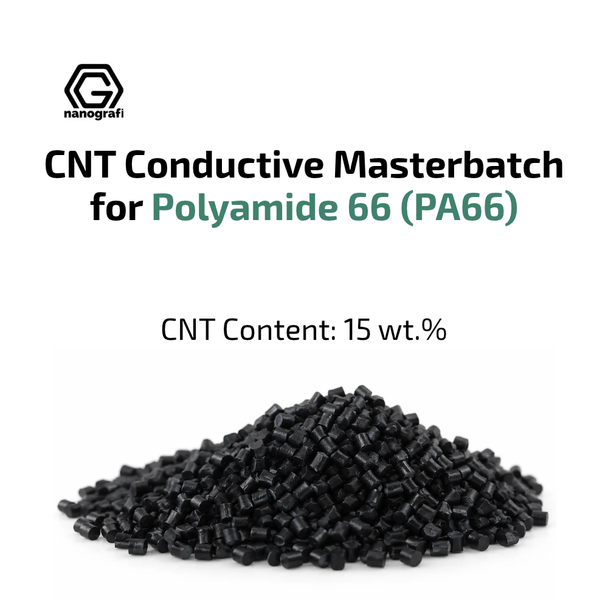
CNT Conductive Masterbatch for Polyamide 66 (PA66), CNT Content: 15 wt.%
- SKU:
- NG10MB0906

Description
Pricing & Availability
For current pricing, product availability, or a customized quotation, please email us at sales@nanografi.com, submit a request through our Request a Quote page, or visit our Contact Us page for further assistance.
Product Overview of CNT Conductive Masterbatch for Polyamide 66 (PA66), CNT Content: 15 wt.%
This conductive masterbatch contains 15 wt.% carbon nanotubes (CNTs) and is designed to bring antistatic and electrically conductive properties to polyamide 66 (PA66)-based products. It combines CNT technology with a convenient concentrate format for incorporation into PA66 formulations. By varying the proportion of masterbatch added to the final polymer blend, manufacturers can develop formulations targeting different surface resistance levels for applications ranging from electrical and electronic components to conductive industrial and automotive parts.
Technical Properties of CNT Conductive Masterbatch for Polyamide 66 (PA66), CNT Content: 15 wt.%
| Masterbatch Loading (%) | Surface Resistance (Ω) | Processing Method |
| 25-30 | 10⁶–10⁸ | Extrusion & Injection |
| 40-50 | 10³–10⁴ | Extrusion & Injection |
Applications of CNT Conductive Masterbatch for Polyamide 66 (PA66), CNT Content: 15 wt.%
- Electrical and Electronic Components: Incorporated into PA66 formulations for equipment components requiring antistatic or electrically conductive properties.
- Industrial ESD Components: Used in the development of PA66-based industrial parts and handling accessories where controlled electrical resistance helps manage static charge accumulation.
- Automotive Components: Added to PA66 formulations for automotive parts requiring static dissipation or electrical conductivity.
- Electronic Packaging and Handling Materials: Used to develop PA66-based carriers and packaging components requiring electrostatic charge control during the handling, storage, and transportation of electronic parts.
Related Products
Related Products

CNT Conductive Masterbatch for Polyamide 6 (PA6), CNT Content: 15 wt.%

CNT Conductive Masterbatch for Polycarbonate (PC), CNT Content: 15 wt.%
CNT Conductive Masterbatch for Polyethylene Terephthalate (PET), CNT Content: 15 wt.%

CNT Conductive Masterbatch for Polypropylene (PP), CNT Content: 20 wt.%
