
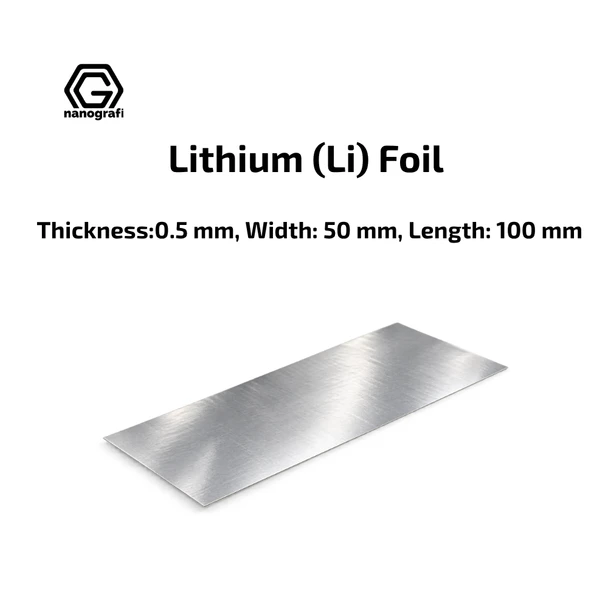
Lithium (Li) Foil Thickness:0.5 mm, Width: 50 mm, Length: 100 mm, Purity: 99.9%
- SKU:
- NG10BEW1067
- Shipping:
- Calculated at Checkout

Description
1 piece: €78
5 pieces: €325
25 pieces: €1240
Contact us for tailored quotes on larger quantities & experience exceptional solutions from our experts.
Product Overview of Lithium (Li) Foil Thickness:0.5 mm, Width: 50 mm, Length: 100 mm
Lithium foil is a highly reactive, silvery-white metal material that quickly tarnishes to a darker shade when exposed to air. It is lightweight, soft, and easily workable, making it suitable for precision cutting or stamping. Due to its chemical nature, it must be handled under controlled conditions to prevent reactions with moisture or oxygen. Its purity and uniform structure make it an ideal choice for advanced electrochemical applications where consistency and reliability are critical.
Technical Properties of Lithium (Li) Foil Thickness:0.5 mm, Width: 50 mm, Length: 100 mm
| Thickness | 0.5 mm | ||||||
| Width | 50 mm | ||||||
| Purity | 99.9% | ||||||
| Appearance | Silvery-white soft metal solid (turns dark gray in air) | ||||||
| Boiling Point | 1317 ℃ | ||||||
| Melting Point | 180.5 ℃ | ||||||
| Spesific Gravity | 0.534 g/cc | ||||||
| Molecular Weight | 6.94 | ||||||
| CAS No | 7439-93-2 | ||||||
| Chemical Composition | Na | Si | Ca | N | Al | Cl | |
| 0.02 | 0.01 | 0.02 | 0.01 | 0.005 | 0.002 |
Applications of Lithium (Li) Foil Thickness:0.5 mm, Width: 50 mm, Length: 100 mm,
- Energy Storage: Widely used as an anode material in lithium-ion and lithium-metal batteries, enabling high energy density and efficient charge cycles.
- Battery Manufacturing: Applied in cylindrical cells where it is wound to maximize surface area, and in button cells where it can be stamped or shaped into compact forms.
- Research & Development: Utilized in laboratories for experimental electrochemical systems, solid-state battery prototypes, and advanced material studies.
- Specialty Uses: Suitable for custom fabrication in micro-batteries, thin-film energy devices, and other niche applications requiring reactive, high-purity lithium sources.
FAQ
Frequently Asked Questions About Lithium (Li) Foil, 0.5 mm Thickness, 99.9% Purity
1. What is high-purity lithium metal foil used for?
High-purity lithium metal foil is used in electrochemical research, lithium-metal battery development, and experimental cell fabrication. Metallic lithium has a high theoretical specific capacity and a very low electrochemical potential, making it an important material for advanced energy storage studies. Lithium foil is also commonly used as a counter or reference electrode in laboratory half-cell configurations. This Nanografi grade is supplied at 99.9% purity with dimensions of 50 mm by 100 mm and a thickness of 0.5 mm. Explore Nanografi's Lithium Foil collection for alternative specifications.
2. What are the dimensions and technical properties of this lithium foil?
This lithium metal foil has a nominal thickness of 0.5 mm, width of 50 mm, length of 100 mm, and purity of 99.9%. Nanografi reports a density of 0.534 g/cm3 and a melting point of 180.5°C. Lithium is a soft, lightweight metal with a silvery-white appearance that can darken rapidly when exposed to air. These properties are relevant to material handling and electrochemical research, although dimensional tolerances and surface quality should be confirmed for precision applications.
3. Can 0.5 mm lithium foil be used in CR2032 coin cell battery research?
Lithium metal foil is commonly used in laboratory coin-cell research, including lithium half-cells where it serves as a counter or reference electrode. A 0.5 mm foil may be evaluated for suitable experimental configurations, depending on cell geometry, spacer selection, and assembly requirements. The supplied sheet dimensions allow researchers to prepare appropriately sized electrodes using qualified laboratory procedures. Compatibility must be assessed for each cell design. Explore Nanografi's Battery Materials collection for related electrochemical research components.
4. What is the difference between lithium metal foil and graphite anode materials?
Lithium metal foil and graphite represent different approaches to negative electrode design. Metallic lithium can act directly as an electrochemically active metal electrode, while graphite stores lithium through reversible intercalation between its carbon layers. Lithium metal offers a substantially higher theoretical specific capacity, but it also introduces challenges involving interfacial stability, nonuniform lithium deposition, and safety. Graphite is widely used in conventional rechargeable lithium-ion batteries. Compare this foil with Nanografi's Conductive Graphite Powder for Lithium Batteries.
5. Why is 99.9% purity important for lithium metal battery research?
High material purity is important in electrochemical research because impurities can influence surface reactions, interfacial stability, and experimental reproducibility. This lithium foil has a specified purity of 99.9%, making it relevant to controlled laboratory investigations. However, purity alone does not establish surface cleanliness, oxide-layer thickness, or suitability for every battery chemistry. Researchers should also consider storage history, packaging, surface condition, and the requirements of their experimental system.
6. Can lithium metal foil be used in solid-state battery research?
Lithium metal is widely investigated as a negative electrode material in solid-state battery research because of its high theoretical capacity and low electrochemical potential. Lithium foil may be used to evaluate interfaces with selected solid electrolytes, including ceramic, polymer, and composite systems. However, lithium compatibility varies significantly among electrolyte materials, and interfacial reactions or mechanical contact limitations can affect performance. Researchers should assess the complete cell design and electrolyte chemistry. Explore Nanografi's Battery Materials for related research materials.
7. What is the difference between 0.5 mm and 0.6 mm lithium foil?
The primary difference is the nominal foil thickness, although the available sheet dimensions may also vary. This product has a thickness of 0.5 mm and dimensions of 50 mm by 100 mm. Nanografi also offers a 0.6 mm lithium foil with dimensions of 25 mm by 100 mm and 99.9% purity. Foil thickness influences the quantity of lithium available per unit area and may affect cell assembly geometry. Researchers can compare this product with other Lithium Foil grades before selecting a material.
8. How does lithium metal foil differ from lithium-ion battery cathode powders?
Lithium metal foil is an elemental lithium material typically investigated as a negative electrode or as a counter electrode in electrochemical experiments. Cathode powders such as lithium iron phosphate (LiFePO4) and lithium cobalt oxide (LiCoO2) are lithium-containing compounds that store and release lithium through electrochemical reactions within their crystal structures. These materials perform different functions and are not interchangeable. Researchers can compare lithium foil with Nanografi's LiFePO4 Cathode Powder and LiCoO2 Cathode Powder.
9. How should lithium metal foil be stored and handled safely?
Lithium metal foil is highly reactive toward moisture and can react with air under unsuitable conditions. It should be stored in the supplier-recommended protective packaging and handled only under appropriately controlled, dry conditions by trained personnel. Contact with water, humid environments, and incompatible chemicals must be avoided. Researchers should consult the product-specific Safety Data Sheet (SDS) and established laboratory procedures before handling or processing lithium metal. Appropriate emergency procedures and extinguishing agents for reactive metal fires must be available; water should not be used on lithium metal fires.
Related Products
Related Products
Lithium (Li) Foil Thickness:0.6 mm, Width: 25 mm, Length: 100 mm, Purity: 99.9%
Lithium Battery Strapping Tape, Width: 10 mm, Thickness: 0.03 mm, Length: 100 m

Nickel Foil, Purity: 99.9+% , Thickness: 0.08mm, Width: 100mm

Nickel Foil, Purity: 99.9+% , Thickness: 0.03mm, Width: 100mm
