
Graphene Oxide, 2-5 Layer, Dia: 4,5 µm
- SKU:
- NG01GO0102
- Shipping:
- Calculated at Checkout



Description
5 gram: 140 €
25 gram: 650 €
100 gram: 1660 €
500 gram: 4950 €
1000 gram: 8640 €
Contact us for tailored quotes on larger quantities & experience exceptional solutions from our experts.
Graphene Oxide (GO) is a chemically functionalized derivative of graphene, produced through the controlled oxidation and exfoliation of graphite. This few-layer grade retains a hexagonal carbon lattice decorated with abundant oxygen-containing functional groups—hydroxyl, epoxy, and carboxyl moieties—that make the material highly hydrophilic and readily dispersible in water and polar solvents, while also providing reactive sites for further chemical modification. With a purity of 99.5%, an average lateral flake diameter of 4.5 µm, and an oxygen content of 25-40%, this GO grade offers a favorable balance between processability and functional group density, making it well suited for solution-based processing, composite fabrication, and surface engineering applications. Buy high-quality Graphene Oxide at Nanografi.
Technical Properties
| Purity | 99.5% |
| Average Number of Graphene Layers | Few Layer Graphene Oxide |
| Average Diameter (µm) | 4.5 |
| Oxygen Content (%O) | 25-40 |
| Color | Dark Brown |
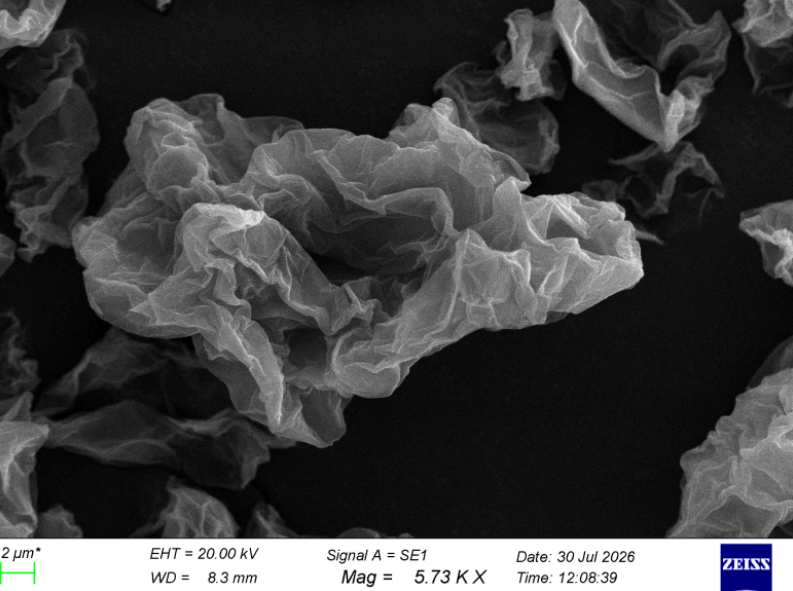
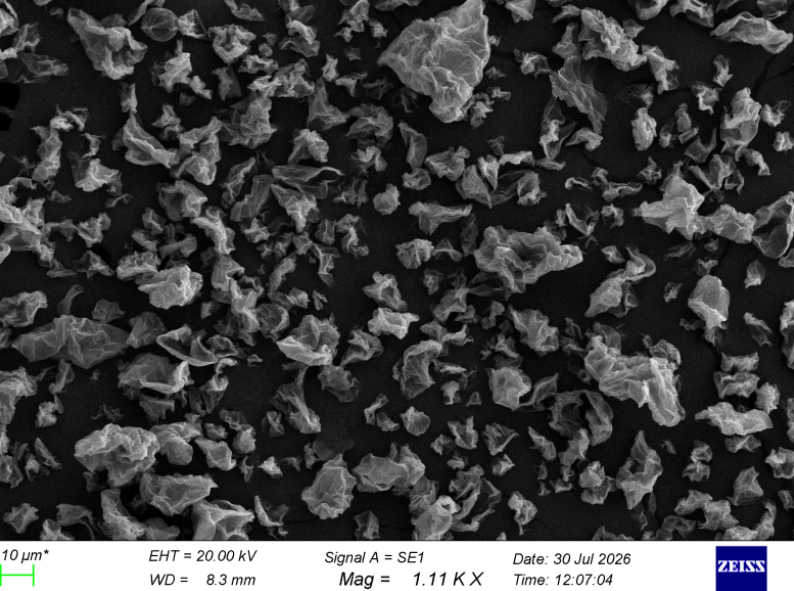
SEM Images
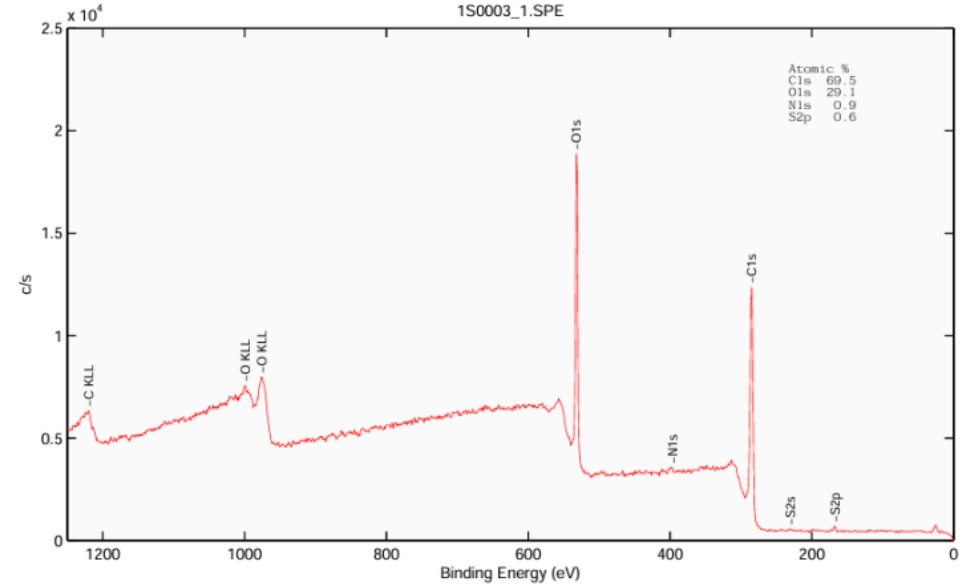
XPS Analysis
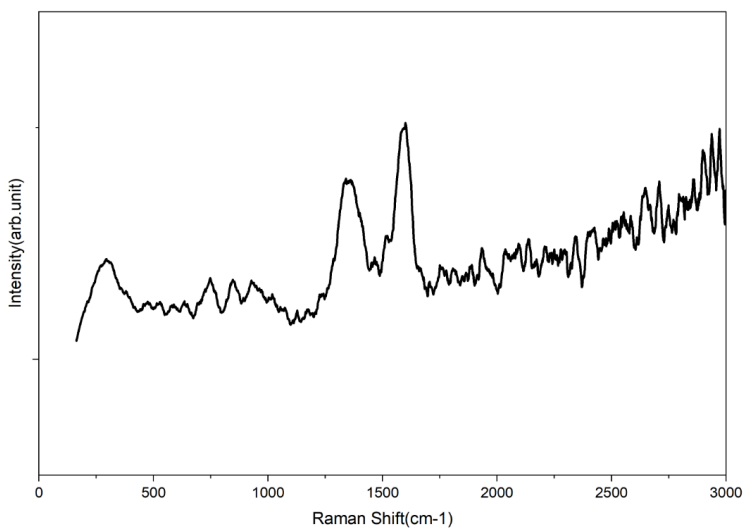
Raman Spectra
Applications
- Polymer & Ceramic Composites: The oxygen-rich surface chemistry of GO promotes strong interfacial bonding and homogeneous dispersion within polymer and ceramic matrices, improving mechanical strength, barrier properties, and thermal stability of the resulting composites.
- Water & Wastewater Treatment: GO's high density of oxygen functional groups and large surface area make it effective as an adsorbent for heavy metals and organic pollutants, and as a building block for GO-based membranes used in filtration and desalination.
- Energy Storage: GO serves as a precursor or conductive scaffold in electrode materials for lithium-ion batteries and supercapacitors, and is frequently combined with metal oxides to enhance charge storage and cycling stability.
- Coatings & Surface Modification: The reactive functional groups on GO enable the formulation of anti-corrosion, barrier, and functional coatings, as well as surface treatments that improve wettability and adhesion on various substrates.
- Sensing & Catalysis: GO's tunable surface chemistry and high specific area support its use as a platform for chemical/biological sensors and as a support material for catalytic and photocatalytic systems.
FAQ
FAQ About Graphene Oxide, 2–5 Layer, 4.5 µm
1) Is this a single-layer or few-layer graphene oxide?
This grade is few-layer graphene oxide, specified at 2–5 layers with an average flake diameter of 4.5 µm and 99.5% purity. Few-layer material retains most of the accessible surface and oxygen chemistry of single-layer GO while being mechanically more robust and less prone to folding during handling. Work that depends strictly on monolayer behaviour — certain membrane and electronic studies — requires a single-layer grade instead.
2) What does the 25–40% oxygen content mean in practice?
Oxygen content is the parameter that defines how graphene oxide behaves. At 25–40% by mass the sheets carry a high density of hydroxyl, epoxy and carboxyl groups, which is what makes the material hydrophilic, dispersible in water without surfactant, and chemically reactive toward coupling and crosslinking. It also means the sheets are electrically insulating in this state; conductivity only returns after reduction.
3) Why is the powder dark brown rather than black?
Dark brown is the characteristic appearance of well-oxidised graphene oxide. Oxidation disrupts the conjugated sp² network that makes graphene black and opaque, so colour is a quick qualitative indicator of oxidation state. Material that appears black may be partially reduced. Colour should be confirmed against the XPS and Raman data supplied rather than relied on alone.
4) What characterization is provided?
SEM images, XPS analysis and Raman spectra accompany the product. For graphene oxide this combination is the meaningful one: XPS quantifies the carbon-to-oxygen ratio and the functional group distribution, Raman shows the D and G bands that describe lattice disorder introduced by oxidation, and SEM confirms flake morphology and size. Together they establish oxidation state, which is the property that governs behaviour.
5) Should I use this powder or a ready-made dispersion?
Powder is the right choice when the material must be dispersed into a non-aqueous medium, incorporated dry, or used at a concentration you control precisely. A pre-made dispersion removes the dispersion step and the batch-to-batch variability it introduces — Nanografi supplies a graphene oxide water dispersion at 0.8 wt% for aqueous work. Dispersing GO powder requires energy input but no surfactant.
6) Can this material be reduced to rGO?
Yes — graphene oxide powder is the standard starting material for producing reduced graphene oxide, whether by chemical, thermal or electrochemical routes, and the degree of reduction achieved is a process variable you control. Reduction restores electrical conductivity but never fully repairs the lattice. The distinction between the two materials and their properties is covered in the difference between graphene oxide and reduced graphene oxide.
7) What forms and grades are available alongside this one?
Nanografi stocks graphene oxide as powder in single-layer and few-layer grades, and as aqueous dispersions at several concentrations, together with reduced and functionalised derivatives. Selection normally follows from the processing route rather than from the material specification alone: dry incorporation favours powder, wet formulation favours dispersion. The full range is listed under graphene oxide.
Related Products
Related Products


Reduced Graphene Oxide (rGO),Purity: 99%, 2-5 layers


Single Layer Graphene Oxide, Purity: 99.5 %
Bismuth Oxide (Bi2O3) Micron Powder, Purity: 99.99%, Size: 1-5 µm

Thulium (III) oxide Micron Powder, Size: 3-5 µm, Purity: 99.9 %

