
PVDF Binder for Li-ion Battery Electrodes (set: 80g )

- SKU:
- NG08BE1101
- Shipping:
- Calculated at Checkout

Description
1 set/95 €
5 sets/450 €
25 sets/ 2035 €
Contact us for tailored quotes on larger quantities & experience exceptional solutions from our experts.
Product Overview of PVDF Binder for Li-ion Battery Electrodes (set: 80g )
PVDF Binder for Li-ion Battery Electrodes that are widely used in the Lithium-ion battery manufacturing industry to hold the active material particles
together and in contact with the current collectors. Characteristic features of PVdF material satisfy the various functions required in the electrode
manufacturing process and battery performance. It brings many advantages to the lithium battery industry when used as a binder in the formulation
of electrodes as well as in the design of the separator. PVDF is already well assessed in many specialty applications such as oil and gas, semiconductors,
membranes for water filtration, plumbing, architectural coatings and photovoltaics. We supply PVDF Binder for Li-ion Battery Electrodes with best prices.
Technical Properties of PVDF Binder for Li-ion Battery Electrodes (set: 80g )
|
Technical Parameter |
Unit |
Index |
Testing |
|
Shape |
/ |
White Powder |
/ |
|
Purity |
% |
≥99.5 |
PVDF |
|
Standard Specific Gravity |
/ |
1.74~1.77 |
ASTM D 792 @23/ 23℃ |
|
Dielectric constant |
100MHz 100Hz |
4.50~5.50 8.00~9.50 |
ASTM D150 |
|
Melting Point |
℃ |
160-168 |
ASTM D 3418 |
|
Melting Index |
g/10min |
1-2 |
/ |
|
Solubility |
/ |
Transparent and dissolvable |
30℃,1hr 1g/10ml NMP |
|
Rotation Viscosity |
mPa·S |
≥2000 |
1g/10ml NMP |
|
Intrinsic Viscosity |
dL/g |
1.0-2.0 |
DMA, 30℃ |
|
Moisture |
% |
≤ 0.1 |
Karl Fischer |
|
Molecular Weight |
/ |
600,000 |
ASTM D 5296-05 |
PVDF Binder for Li-ion Battery Electrodes (set: 80g )
- Lithium-Ion Battery Cathodes: Used as a polymer binder in cathode formulations to support active material cohesion, electrode adhesion, and mechanical integrity.
- Lithium-Ion Battery Anodes: Applied in anode formulations to bind active material particles and improve adhesion to current collectors.
- Battery Electrode Slurry Preparation: Used in solvent-based electrode slurries, particularly N-methyl-2-pyrrolidone (NMP) formulations, to support uniform mixing and electrode coating.
- Electrode Coating and Manufacturing: Helps maintain electrode structural integrity during coating, drying, calendaring, and subsequent battery assembly processes.
- Battery Separator Research: Investigated in polymer-based separator coatings and membrane formulations for rechargeable lithium-ion batteries.
- Advanced Battery Material Research: Used in studies involving binder concentration, electrode adhesion, mechanical stability, and electrochemical performance optimization.
FAQ
Frequently Asked Questions About PVDF Binder for Li-ion Battery Electrodes, 80 g
1. What is PVDF binder used for in lithium-ion battery electrodes?
Polyvinylidene fluoride (PVDF) is a fluoropolymer binder widely used in lithium-ion battery electrode manufacturing, particularly in cathode formulations. Its primary function is to hold active material particles and conductive additives together while supporting adhesion to the current collector. PVDF also provides chemical resistance and mechanical cohesion under suitable electrode operating conditions. This Nanografi product is supplied as a high-purity white powder in an 80 g package. Explore Nanografi's Cathode Materials collection for complementary electrode components.
2. What are the technical specifications of this PVDF binder?
Nanografi specifies a PVDF purity of at least 99.5%, molecular weight of approximately 600,000, standard specific gravity of 1.74-1.77, and melting point of 160-168°C. The product is supplied as a white powder with a moisture content of no more than 0.1%. Its listed intrinsic viscosity is 1.0-2.0 dL/g, while the melt index is 1-2 g/10 min. These properties are relevant to polymer processing, solvent compatibility, and electrode formulation. Researchers can explore Nanografi's Raw Materials for Battery Applications for related materials.
3. Is PVDF binder soluble in NMP for battery electrode slurry preparation?
PVDF is commonly processed using N-Methyl-2-pyrrolidone (NMP), a solvent widely used in conventional lithium-ion battery cathode manufacturing. Nanografi's product specifications report transparent dissolution at a concentration of 1 g PVDF per 10 mL NMP under a stated test condition of 30°C for one hour. Actual dissolution behavior depends on polymer grade, concentration, temperature, and mixing conditions. NMP presents significant health hazards and requires appropriate exposure controls. Researchers can explore Nanografi's Battery Materials collection for complementary electrode-processing materials.
4. What is the difference between PVDF and SBR binders for lithium-ion batteries?
PVDF and styrene-butadiene rubber (SBR) are polymer binders used in different electrode processing systems. PVDF is commonly associated with solvent-based cathode formulations, while SBR latex is frequently used in aqueous graphite anode processing. Their mechanical behavior, solvent compatibility, adhesion characteristics, and processing requirements differ. Neither binder is universally preferable for every battery chemistry. Researchers should select a binder according to the active material and manufacturing method. Compare this product with Nanografi's SBR Binder for Li-ion Battery Anodes.
5. Can PVDF binder be used with LiFePO4, LiCoO2, and NMC cathode materials?
PVDF is commonly investigated as a binder for lithium-ion battery cathodes containing lithium iron phosphate (LiFePO4), lithium cobalt oxide (LiCoO2), and nickel manganese cobalt oxide (NMC) active materials. In these formulations, PVDF helps maintain particle cohesion and adhesion during electrode fabrication. Binder concentration, solvent selection, conductive additive loading, and drying conditions should be optimized for the selected chemistry. Researchers can explore Nanografi's LiFePO4 Cathode Powder and LiCoO2 Cathode Powder for related research.
6. How does PVDF binder affect electrode adhesion and slurry properties?
PVDF contributes to the mechanical integrity of battery electrodes by binding active particles and conductive additives into a cohesive coating. Its molecular weight, concentration, solvent interactions, and distribution can influence slurry viscosity, coating uniformity, and adhesion to the current collector. Excessive binder loading may reduce the proportion of electrochemically active material, while insufficient binder may compromise electrode cohesion. The optimal formulation depends on the selected active powder, conductive additive, coating method, and target electrode characteristics.
7. Can PVDF binder be combined with conductive carbon black in cathode formulations?
PVDF can be combined with conductive carbon additives in compatible lithium-ion battery cathode formulations. PVDF provides mechanical cohesion, while conductive carbon black helps establish electronic pathways between active material particles. Uniform distribution of both components is important for achieving consistent electrode coatings and electrical connectivity. Researchers should optimize mixing sequence, solids content, and drying conditions for their selected materials. Compare Nanografi's C-NERGY Super P and C-NERGY SUPER C45 Conductive Carbon Black.
8. What is the difference between PVDF and PTFE binders for battery electrodes?
PVDF and polytetrafluoroethylene (PTFE) are fluoropolymers used in different electrode manufacturing approaches. PVDF is widely used in solvent-based slurry processing, particularly with NMP, while certain PTFE grades are investigated in dry-electrode processing through fibrillation and in other specialized formulations. Their mechanical behavior, processing requirements, and compatibility with electrode materials differ. PTFE products are not automatically interchangeable with PVDF in conventional slurry recipes. Researchers can compare this product with Nanografi's PTFE Condensed Liquid Binder for Li-ion Batteries.
9. How should PVDF binder powder be stored and handled safely?
PVDF binder powder should be stored in tightly sealed containers under clean, dry conditions, following the product-specific Safety Data Sheet (SDS). Nanografi specifies a moisture content of no more than 0.1% for this grade, making moisture and contamination control relevant to reproducible electrode processing. Powder handling should minimize airborne dust through appropriate ventilation and protective equipment. Processing temperatures should remain within the supplier's recommended limits to avoid polymer degradation and potentially hazardous decomposition products. When preparing NMP-based slurries, researchers must also follow the solvent's safety requirements.
Related Products
Related Products
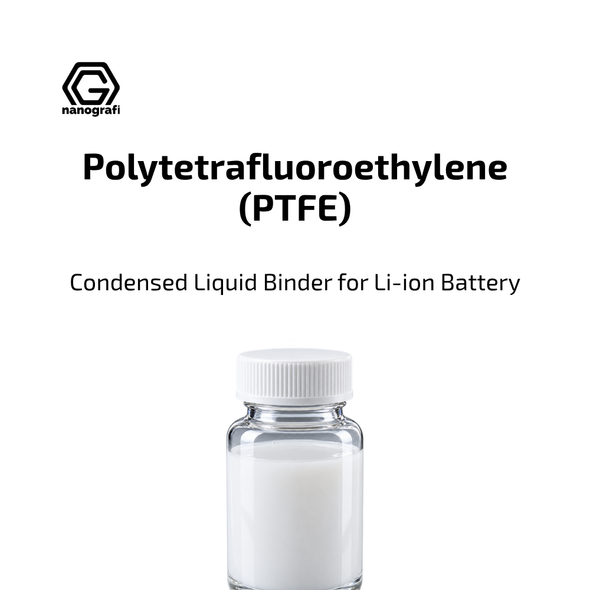
Polytetrafluoroethylene (PTFE) Condensed Liquid Binder for Li-ion Battery

Styrene-Butadiene Rubber (SBR) Binder for Li-ion Battery Anode Materials
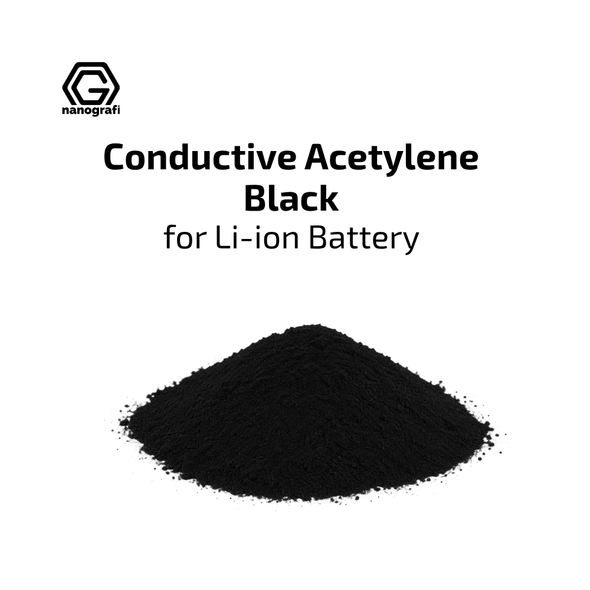
Conductive Acetylene Black for Li-ion Battery Anode/Cathode

Carboxymethyl Cellulose (CMC) Micron Powder for Li-ion Battery Anode Materials
