
10 Uses of Calcium Oxide in Daily Life
Few chemical compounds touch as many parts of daily life as calcium oxide. Known for centuries as quicklime or burnt lime, this simple combination of calcium and oxygen quietly underpins the buildings we live in, the steel in our cars, the water we drink, and the crops we grow.
It is produced on an enormous scale, with global annual output measured in hundreds of millions of tonnes, yet most people never see it directly because it is consumed within industrial processes. This article explains what calcium oxide is, how it is made, and ten of its most important uses, with technical figures checked against verified sources to correct several errors that commonly circulate online.

What Is Calcium Oxide?
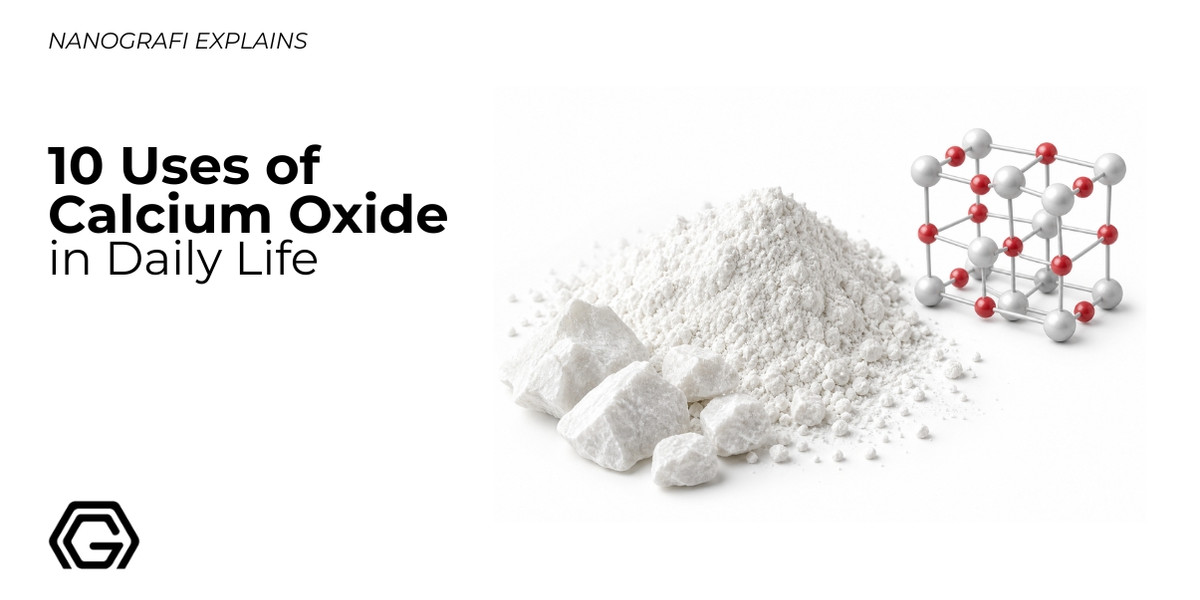
Calcium oxide is an inorganic compound with the formula CaO. At room temperature it is a white, crystalline, alkaline, and caustic solid. It is most often called quicklime or burnt lime. The broader term "lime" refers to calcium-containing inorganic materials in which oxides, hydroxides, and carbonates of calcium predominate, so quicklime specifically denotes the single compound CaO.
Calcium oxide is produced by heating limestone (calcium carbonate, CaCO3) to high temperatures in a process called calcination, which drives off carbon dioxide:
CaCO3 → CaO + CO2 (at roughly 900 to 1000 °C)
When water is added to quicklime, it reacts to form calcium hydroxide, Ca(OH)2, also known as slaked lime or hydrated lime. This reaction is strongly exothermic and releases significant heat:
CaO + H2O → Ca(OH)2 + heat
This vigorous, heat-releasing reaction is the basis for several of the applications described below.
10 Key Uses of Calcium Oxide
1. Steelmaking
The single largest use of quicklime is as a flux in steel production, particularly the basic oxygen steelmaking (BOS) process. Roughly 30 to 50 kg of quicklime is used per tonne of steel. It neutralizes acidic oxides such as silica (SiO2), alumina (Al2O3), and iron oxide (Fe2O3), forming a basic molten slag that carries away impurities like silicon, phosphorus, and sulfur. Steel manufacturing accounts for the largest share of global calcium oxide demand.
Correction note: Some versions of this article state the figure as "30 to 59 kg per ton." The widely cited range is 30 to 50 kg (about 65 to 110 lb) per tonne of steel.
2. Cement and Construction
Calcium oxide is a core ingredient in the production of cement and mortar. It contributes to the calcium silicate compounds that give concrete its strength and durability. Ground quicklime is also used to make aerated concrete blocks, typically with densities of about 0.6 to 1.0 g/cm³. In this way, CaO is indirectly present in nearly every home, building, road, and bridge.
3. Water and Wastewater Treatment
In water treatment, calcium oxide is added to water to form calcium hydroxide, which raises pH and assists a process called lime softening. This helps remove hardness, heavy metals, and impurities from drinking water, and supports the removal of bacteria and organic matter. In wastewater treatment, it neutralizes acidic effluents and precipitates dissolved metals. At the nanoscale, calcium oxide nanoparticles offer a high surface area that makes them especially effective for adsorption, water purification, and antibacterial action.
4. Agriculture and Soil Stabilization
Calcium oxide is widely used in agriculture to correct acidic soils, a practice known as liming. By raising soil pH, it improves nutrient availability and supports better crop growth. Quicklime and hydrated lime also increase the load-bearing capacity of clay-containing soils: they react with finely divided silica and alumina to produce calcium silicates and aluminates that have cementing properties, which is valuable in road building and foundation work.
5. Flue-Gas Desulfurization
Calcium oxide and its derivative calcium hydroxide are used to scrub sulfur dioxide (SO2) from the exhaust gases of power plants and industrial facilities. The lime reacts with acidic sulfur compounds to form calcium sulfite and sulfate, reducing harmful emissions. This environmental application is one of the fastest-growing areas of demand.
6. Paper and Pulp Production
In the kraft process used to make paper, calcium oxide plays a role in regenerating sodium hydroxide from sodium carbonate, allowing key chemicals to be recovered and reused. This makes the pulping cycle more efficient and less wasteful.
7. Sugar Refining
Calcium oxide is used in the purification of sugar. Lime is added to raw sugar juice to help remove impurities, after which carbon dioxide is introduced to precipitate out the excess calcium as calcium carbonate, clarifying the syrup before further refinement.
8. Self-Heating and Portable Heat Sources
The exothermic reaction between quicklime and water provides a convenient, flameless source of heat. Roughly one litre of water combined with about 3 kg of quicklime releases enough energy to warm food or beverages. This principle is used in self-heating cans and portable cooking and warming kits.
9. Chemical Manufacturing
Calcium oxide is a feedstock for producing many other chemicals, including calcium carbide, calcium hypochlorite (a bleaching and disinfecting agent), precipitated calcium carbonate (PCC), and caustic soda. As a recognized food additive (E number E529), purified grades also serve as an acidity regulator and flour treatment agent.
10. Rock Breaking and Demolition
The expansion that occurs when quicklime reacts with water can be harnessed to split rock. A sealed quicklime cartridge is placed into a drilled hole and injected with water; the resulting steam and the larger volume of the hydrated solid generate pressure that can fracture the rock. This method works on moderately hard rock but is less effective on very hard stone.
A note on a historical myth: Quicklime was once believed to accelerate the decomposition of bodies. In reality, it tends to mask the odor of decomposition and can even slow it under some conditions, which likely gave rise to the mistaken belief.

If you are interested in Dental Applications of Nanomaterials,
you can read our blog post here.
Safety Considerations
Calcium oxide is a strong irritant to skin, eyes, and mucous membranes. Because contact with moisture, including perspiration, triggers an exothermic reaction, it can cause chemical burns. It should be handled with appropriate protective equipment and stored in sealed, moisture-proof containers away from water.
Frequently Asked Questions
What is calcium oxide commonly known as? It is most commonly called quicklime or burnt lime. When combined with water it becomes calcium hydroxide, known as slaked or hydrated lime.
What is the largest use of calcium oxide? Steelmaking is the single largest use, where quicklime acts as a flux to remove impurities, accounting for the biggest share of global demand.
Is calcium oxide dangerous? It is caustic and reacts exothermically with water, so it can cause burns and irritation. It should be handled carefully with protective gear.
How is calcium oxide made? It is produced by heating limestone (calcium carbonate) to roughly 900 to 1000 °C, which releases carbon dioxide and leaves calcium oxide behind.
Conclusion
Calcium oxide is one of the most versatile and heavily produced industrial chemicals in the world. From the steel beams and concrete in our cities to the water in our taps and the crops in our fields, quicklime plays a quiet but essential role in modern life. Its simple chemistry, abundant raw material, and powerful reactivity ensure it will remain a cornerstone compound across many industries for years to come. For laboratory and research use, high-purity grades are available as calcium oxide micron powder, and you can read more about synthesis and properties in this overview of calcium oxide nanoparticles.
References
National Center for Biotechnology Information. (n.d.). Calcium oxide (PubChem Compound Summary). U.S. National Library of Medicine. https://pubchem.ncbi.nlm.nih.gov/compound/Calcium-oxide
National Lime Association. (n.d.). Metallurgical uses of lime. https://www.lime.org/resource/metallurgical-uses-of-lime/
Wikipedia. (2026). Calcium oxide. https://en.wikipedia.org/wiki/Calcium_oxide
Recent Posts
-

Advanced Materials for Humanoid Robots: Actuators, Sensors and E-Skin
Humanoid robots are leaving the lab. They now walk warehouse floors, handle parts on assembly lines …23rd Oct 2026 -

What Is Conductive Masterbatch? CNT, Carbon Black and Graphene Compared
A conductive masterbatch is a concentrated blend of a conductive carbon additive and a carrier polym …14th Oct 2026 -

Biomaterials for Implants: Titanium vs Nitinol vs Hydroxyapatite Coatings
Implantable medical devices operate under very different mechanical and biological conditions. A hip …7th Oct 2026