
A New Phase in Twisted Double Bilayer Graphene and High-Temperature Superconductivity
New Phase in Twisted Double Bilayer Graphene and High-Temperature Superconductivity
Vahid Javan Kouzegaran
Analytical Chemist (Ph.D.) / Nanografi Nano Technology
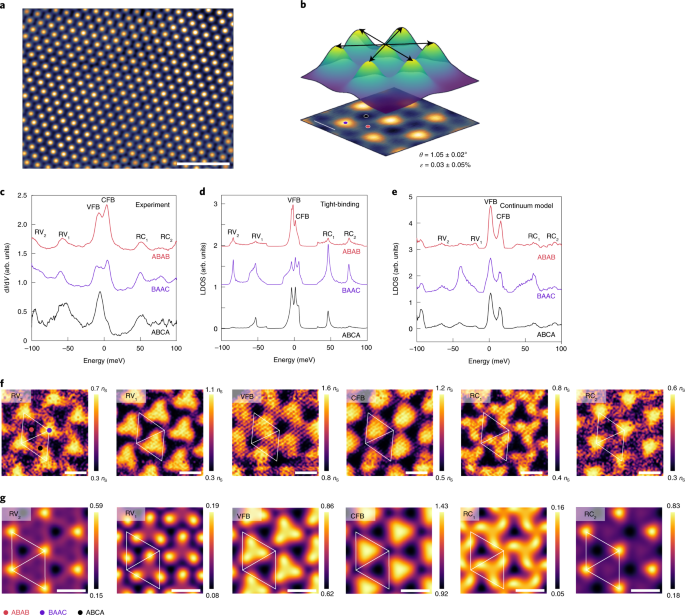
In recent collaborative research published on Nature magazine, a three-fold rotational symmetry breaking was reported in moiré nematic graphene, the twisted double bilayer graphene resulting in “correlated electronic phases” (CEP). The moiré pattern gives rise to a large unit cell and forms flat bands near the Fermi level. In the newly published study, graphene with irregularly aligned parallel hexagonal superlattices has been found to exhibit energy gaps as flat bands specifically due to strong electron-electron interactions.
In CEPs, charge, spin, orbital and lattice degrees of freedom result in competing interactions which in turn, lead to phase transitions and the emergence of exotic phases including manganites & high-temperature superconductivity, charge stripes in cuprates, even phase separation in some manganites and cuprates. Superconductivity, for example, is one the most critical areas of research and technology today which is particularly obtained at cryogenic temperatures of around -270℃ (3 K) when Cooper pairs are formed through the entanglement of so many pairs of electrons. However, maintaining these cryogenic temperatures for long time intervals is too challenging. Superconductors are one of the main building blocks of quantum computers which are 100 million times faster than conventional computers.Quantum computers are expected to revolutionize digital technology, data analysis, robotics, machine learning, the Internet, and blockchain technology.
To get more information about Application Areas of Graphene,
you can read our blog post.
Read more: https://www.nature.com/articles/s41567-021-01438-2
Recent Posts
-

Coconut Shell Activated Carbon: Why It Outperforms Coal- and Wood-Based Alternatives
Not all activated carbon starts from the same place, and the raw material behind it matters more tha …4th Aug 2026 -

Graphene Coating Technology: A New Standard in Corrosion and Wear Protection
Every metal surface is, in a sense, already losing a slow chemical war. Oxygen, moisture, and dissol …28th Jul 2026 -
Graphene Dispersion vs CNT Dispersion: Use Cases and How to Choose
If you have ever tried to formulate a conductive ink, a battery slurry, or an anti-static coating, y …16th Jul 2026