
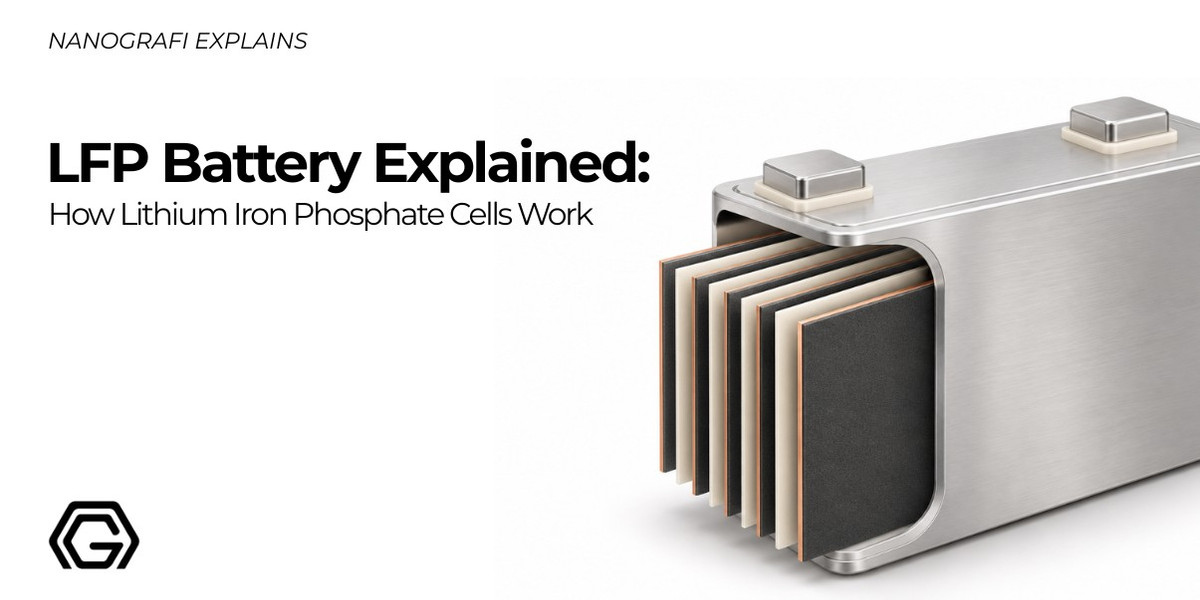
LFP Battery Explained: How Lithium Iron Phosphate Cells Work
An LFP battery is a lithium-ion battery that uses lithium iron phosphate (LiFePO4) as its cathode material. It gives up some energy density compared with nickel-based cells, and in return offers high thermal stability, long cycle life and a cathode free of cobalt and nickel.
That trade has made LFP one of the most widely used battery chemistries for electric buses, standard-range electric cars and stationary energy storage. This guide explains what an LFP battery is, how its crystal structure works, what goes inside a cell, where its strengths and limits lie, and which materials researchers use to build LFP cells in the lab.
What Is an LFP Battery?
An LFP battery is named after its cathode, lithium iron phosphate, also called lithium ferro phosphate. Like every lithium-ion cell, it stores energy through reversible electrochemical reactions at the two electrodes: during charging the ions leave the cathode and enter the anode, and during discharge they return.
What sets LFP apart is the cathode chemistry. Instead of a layered metal oxide such as NMC or LCO, it uses an olivine-type phosphate framework containing iron, which is abundant and inexpensive. The nominal cell voltage is around 3.2 V, slightly lower than nickel-based chemistries, and the theoretical specific capacity of LiFePO4 is close to 170 mAh/g.
LiFePO4 was first proposed as a cathode in 1997 by John Goodenough's group at the University of Texas at Austin. Today the active material is supplied as a fine powder, such as LiFePO4 powder for Li-ion battery cathodes, and processed into electrodes. For how LFP sits among the other cathode families, see our guide to battery cathode materials.
LiFePO4 Olivine Crystal Structure
LiFePO4 crystallizes in the olivine structure, an orthorhombic lattice in which phosphate (PO4) tetrahedra and iron–oxygen (FeO6) octahedra form a rigid three-dimensional framework. Lithium ions sit in channels running through this framework and move along them during charge and discharge.
The strong phosphorus-oxygen bonds are the reason LFP is so stable. They hold oxygen tightly in the lattice, so the cathode does not readily release oxygen when the cell overheats. This is a key difference from layered oxide cathodes and the main source of LFP's safety reputation.
The same structure also creates LFP's biggest challenge: very low electronic conductivity. Pristine LiFePO4 conducts electrons poorly, which limits how fast a cell can charge and discharge. Two approaches help mitigate these transport limitations. The first is carbon coating, in which each particle is wrapped in a thin conductive carbon layer. The second is reducing particle size to the nanoscale, which shortens the distance that lithium ions and electrons have to travel.
In practice, LFP electrodes are almost always made with conductive carbon additives such as Super C65 conductive carbon black, which build an electron pathway between the active particles.
Inside an LFP Cell: Cathode, Anode, Separator, Electrolyte
An LFP cell has the same basic architecture as any lithium-ion cell. What changes is the cathode material; the other components are largely shared with other chemistries.
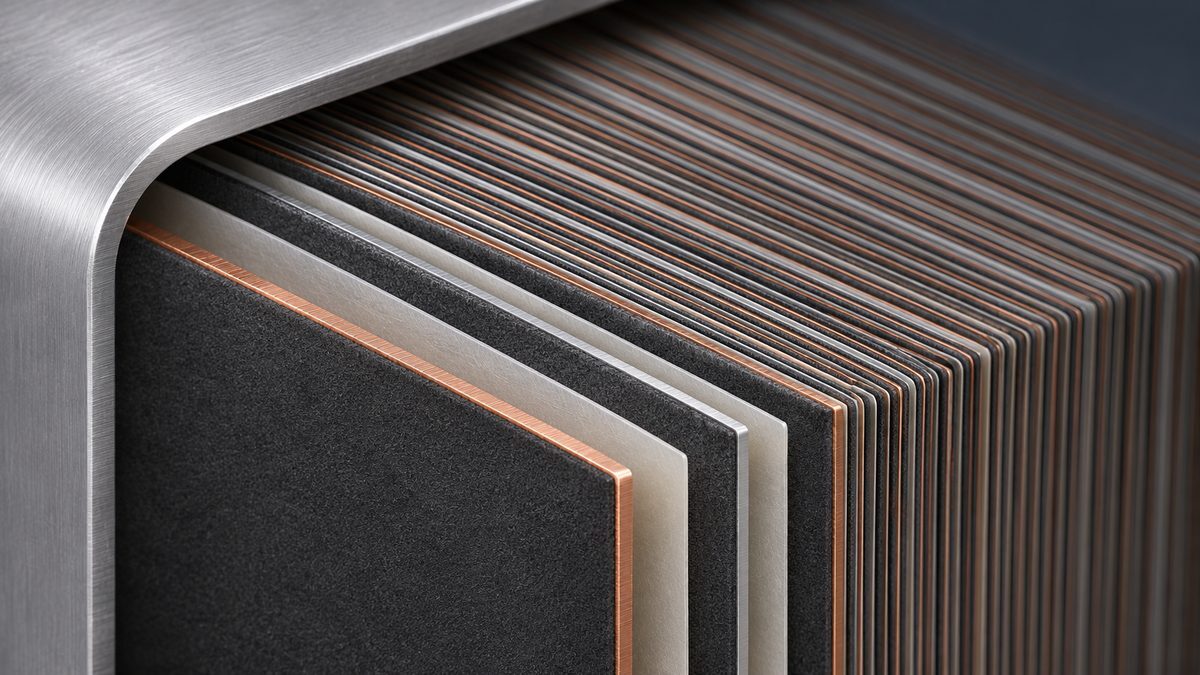
- Cathode: LiFePO4 mixed with conductive carbon and a binder, coated onto aluminum foil. For lab work, ready-made LiFePO4 coated aluminum foil removes the slurry and coating steps.
- Anode: usually graphite coated onto copper foil. Common choices are among our graphite anode materials, including MCMB graphite powder, with a copper foil current collector.
- Separator: a porous polymer film that keeps the electrodes apart while letting ions pass. Polyethylene and polypropylene films are the most common battery separators.
- Electrolyte: a lithium salt dissolved in organic carbonate solvents. The most commonly used salt is lithium hexafluorophosphate (LiPF₆).
The binder holds the electrode together and bonds it to the foil. For LFP cathode slurries, PVDF is a common binder and is typically dissolved in NMP.
Advantages and Limitations of LFP
Many of LFP's advantages stem from its cathode chemistry.
- Thermal stability: the phosphate framework holds oxygen firmly, which makes the cathode more thermally stable than nickel-rich cathodes and can reduce the severity of thermal runaway.
- Long cycle life: the olivine lattice changes little in volume as lithium moves in and out, which contributes to long cycle life.
- No cobalt or nickel: iron and phosphate are abundant, which lowers material cost and avoids dependence on nickel and cobalt for the cathode active material.
- Flat voltage curve: the cell delivers a steady voltage over most of its discharge, which simplifies power management.
The limitations are just as clear.
- Lower energy density: a lower average cell voltage and lower cathode specific capacity compared with nickel-rich chemistries generally mean more battery mass for the same stored energy.
- Weaker cold-weather performance: low temperatures slow lithium transport and reduce available capacity.
- Harder state-of-charge estimation: the same flat voltage curve that helps power management makes it difficult to read charge level from voltage alone.
LFP vs NMC vs NCA
LFP, NMC and NCA are three widely used cathode families in electric vehicle batteries, and each one is a different balance of energy, safety and cost.
| Property | LFP | NMC | NCA |
| Cathode structure | Olivine phosphate | Layered oxide | Layered oxide |
| Nominal voltage | ~3.2 V | ~3.6 to 3.7 V | ~3.6 V |
| Energy density | Lower | High | High |
| Thermal stability | Very high | Generally lower than LFP | Generally lower than LFP |
| Cycle life | Very long | Generally shorter than LFP | Generally shorter than LFP |
| Cobalt and nickel in the cathode active material | None | Yes | Yes |
| Typical use | Buses, standard-range EVs, grid storage | Long-range EVs, electronics | Long-range EVs |
NMC and NCA win where every kilogram counts, while LFP wins where safety, lifetime and cost matter most. The move toward nickel-rich, low-cobalt NMC grades is covered in our article on NMC and lithium batteries.
Where LFP Batteries Are Used
LFP is often used in applications where a long service life and high safety margin outweigh the need for maximum energy per kilogram.
- Electric vehicles: standard-range passenger cars, buses and commercial vehicles.
- Stationary energy storage: grid-scale storage and home batteries paired with solar panels, where battery weight is generally less critical than in electric vehicles.
- Backup power: uninterruptible power supplies and telecom stations.
- Light mobility, material handling, marine and recreational vehicles: e-bikes, forklifts, boats and recreational vehicles.
In stationary storage, LFP now competes with sodium-ion batteries, which avoid lithium entirely. Their electrode chemistry is explained in our guide to sodium-ion cathode materials.
Materials for LFP Cell Research
A lab-scale LFP cell, usually built in coin cell format, needs the full set of components: an LFP cathode, typically prepared by coating LiFePO₄, a conductive additive and a binder onto aluminum foil, a graphite negative electrode for a full cell or a lithium metal counter electrode for a half-cell, a separator, an electrolyte, and the coin cell hardware.
Research groups working on LFP often study carbon coating methods, particle size, doping, and conductive networks made from graphene or carbon nanotubes. For a step-by-step guide to assembling a test cell, see making a lithium-ion coin cell, and browse our coin cell materials for cases, spacers and springs.
Conclusion
LFP batteries trade some energy density for safety, long life and a cobalt-free cathode, and that trade has made them one of the main chemistries in electric vehicles and energy storage. Their performance depends heavily on materials engineering: carbon coating, particle size and a well-built conductive network turn a poorly conducting phosphate into a high-performance cathode. Nanografi supplies LiFePO4 powder, coated electrodes and the supporting cell materials for researchers developing the next generation of LFP cells.
FAQ
What does LFP stand for in batteries? LFP stands for lithium ferro phosphate, another name for lithium iron phosphate (LiFePO4). The "F" comes from Fe, the chemical symbol for iron.
Is an LFP battery a lithium-ion battery? Yes. An LFP battery is a type of lithium-ion battery that uses LiFePO4 as its cathode. The comparison people usually mean is LFP versus other lithium-ion cathodes such as NMC or NCA.
Why are LFP batteries considered safer? The phosphate framework in LiFePO4 holds oxygen tightly, so the cathode does not readily release oxygen when the cell overheats. This contributes to higher cathode thermal stability and can reduce the severity of thermal runaway if it occurs.
What is the main disadvantage of LFP? Lower energy density. Compared with batteries that use nickel-rich cathodes, LFP batteries generally have a lower average cell voltage and lower cathode specific capacity, so they typically weigh more for the same stored energy.
Why is carbon added to LiFePO4? Pristine LiFePO4 conducts electrons poorly. A thin carbon coating applied to particle surfaces, together with conductive carbon additives in the electrode, improves electron transport and can improve performance at higher charge and discharge rates.
References
- Padhi, A. K., Nanjundaswamy, K. S. & Goodenough, J. B. Phospho-olivines as positive-electrode materials for rechargeable lithium batteries. Journal of the Electrochemical Society 144(4), 1188-1194 (1997). DOI: 10.1149/1.1837571
- Chung, S.-Y., Bloking, J. T. & Chiang, Y.-M. Electronically conductive phospho-olivines as lithium storage electrodes. Nature Materials 1, 123-128 (2002). DOI: 10.1038/nmat732
- Yuan, L.-X. et al. Development and challenges of LiFePO4 cathode material for lithium-ion batteries. Energy & Environmental Science 4, 269-284 (2011). DOI: 10.1039/c0ee00029a
- Wang, J. & Sun, X. Olivine LiFePO4: the remaining challenges for future energy storage. Energy & Environmental Science 8, 1110-1138 (2015). DOI: 10.1039/c4ee04016c
- Xie, J. & Lu, Y.-C. A retrospective on lithium-ion batteries. Nature Communications 11, 2499 (2020). DOI: 10.1038/s41467-020-16259-9
Recent Posts
-
LFP Battery Explained: How Lithium Iron Phosphate Cells Work
An LFP battery is a lithium-ion battery that uses lithium iron phosphate (LiFePO4) as its cathode ma …27th Nov 2026 -
Conductive Masterbatch by Polymer: PP, LLDPE, PET, ABS, PA6/PA66 and PC
A masterbatch only performs as well as its carrier allows. The carrier resin must be compatible with …9th Nov 2026 -

What Is Masterbatch? Types, Manufacturing Process and Applications
A masterbatch is a concentrated mixture of pigments, functional additives or both, dispersed in a po …9th Nov 2026