
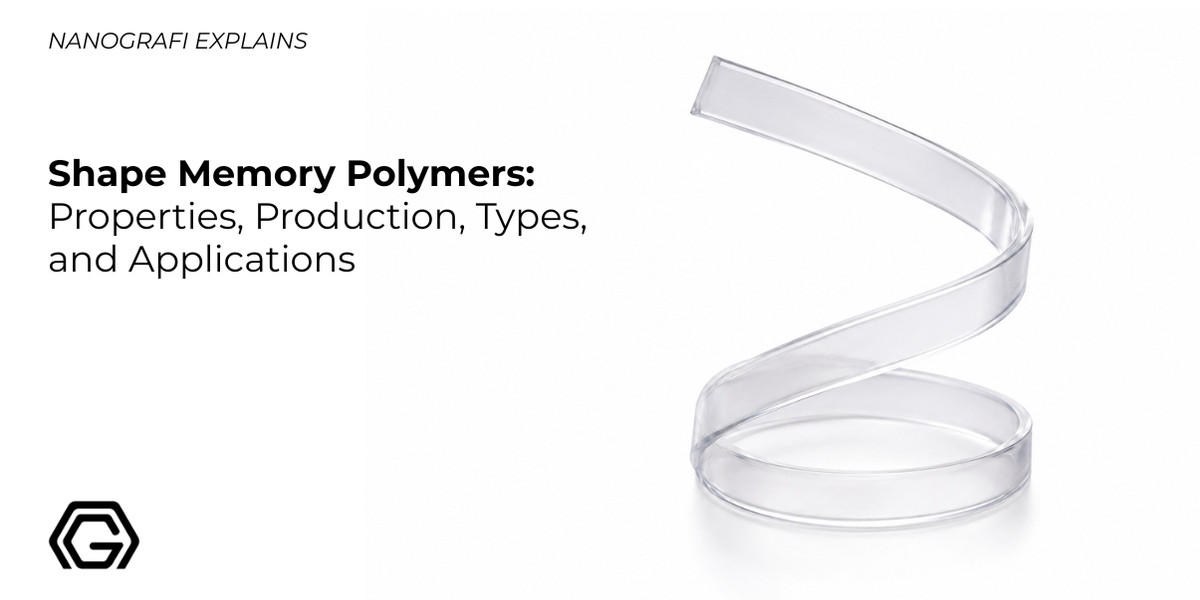
Shape Memory Polymers: Properties, Production, Types, and Applications
Shape memory polymers (SMPs) are smart materials that can be deformed into a temporary shape and then return to their original, "permanent" shape when triggered by an external stimulus, most commonly heat, but also light, moisture, electric current, or magnetic fields. Unlike shape memory alloys such as Nitinol, which rely on a metallic crystal-phase transformation, SMPs achieve this effect through their polymer network structure, which makes them lighter, cheaper to process, and capable of much larger recoverable deformations. This combination of light weight and large, controllable movement is why SMPs have moved from a laboratory curiosity into mainstream biomedical, aerospace, and consumer products over the past two decades, and why they are now studied as a foundation for four-dimensional (4D) printing, where a printed object is designed to change shape after fabrication in response to a stimulus.
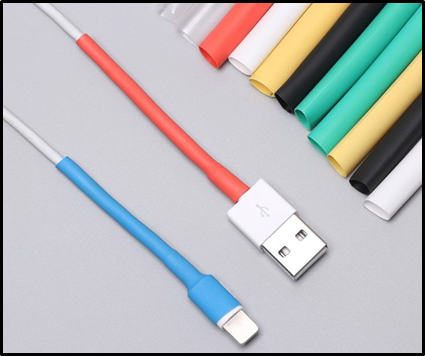
Heat Shrink Tubes.
"The first commercial application dates back to the 1960s, with the production of cross-linked polyethylene (PE) heat shrink to be used as a pipe cover."
In this article, we’ll look at the production, properties, importance and applications of Shape Memory Polymers.
How Shape Memory Polymers Work
An SMP network contains two structural components: netpoints, which fix the permanent shape through physical entanglements, crystalline domains, or covalent cross-links, and a switching segment, whose transition, for example a glass transition or melting temperature, is used to temporarily lock in a deformed shape. When the material is heated above the switching temperature, deformed, and then cooled while held in the new shape, the temporary shape is "frozen in." Re-heating above the switching temperature releases the stored elastic energy and the polymer returns to its permanent shape. This cycle can typically be repeated many times in thermoplastic formulations, and the recovery speed and force can both be tuned by adjusting the polymer chemistry and filler content.
Beyond the classic one-way effect described above, researchers have also developed two-way shape memory polymers, which can switch reversibly between two distinct shapes under repeated heating and cooling without needing to be manually redeformed each cycle. This is achieved by carefully controlling crystallization behavior within the switching segment, and it opens up applications such as reversible actuators and self-adjusting components that do not require an external mechanical reset.
Shape Memory Polymers vs. Shape Memory Alloys
| Shape Memory Polymers | Shape Memory Alloys (e.g., Nitinol) | |
|---|---|---|
| Recoverable strain | Very high (up to several hundred percent) | Typically under 8% |
| Density and weight | Low | High |
| Processing cost | Low, easy to mold and extrude | Higher, requires metallurgical processing |
| Actuation force | Lower | Higher |
| Typical use | Biomedical devices, packaging, textiles, self-healing coatings | Actuators, medical stents, aerospace fittings |
For applications that need high force and durability rather than large, low-cost deformation, shape memory alloys built around Ni-Ti (Nitinol) alloy powder are usually the better starting point. In practice, many advanced designs combine both material classes, using a rigid Nitinol frame for load-bearing force and an SMP skin or coating for large-area shape adaptation.
Production Methods
SMPs are typically produced using standard polymer-processing routes adapted to introduce the required netpoint and switching-segment architecture:
- Bulk polymerization and crosslinking. Thermosets such as crosslinked polyurethanes are cured with a defined crosslink density that sets the permanent shape. The degree of crosslinking directly controls both the maximum recoverable strain and the mechanical stiffness of the final part.
- Melt processing (extrusion, injection molding). Used for thermoplastic SMPs, which can be reprocessed and are easier to shape into complex geometries, making them well suited to high-volume manufacturing.
- Solvent casting and blending. Used to combine SMPs with fillers or a second polymer, such as PLA, to boost shape-recovery efficiency or mechanical strength, and to produce thin films or coatings that would be difficult to achieve by melt processing alone.
- Composite reinforcement. Adding carbon nanotubes, graphene, or metal nanoparticles improves stiffness and electrical conductivity, and can enable electro-active or light-active triggering instead of pure heat activation, since a conductive filler network allows the material to be heated internally through resistive (Joule) heating.
Each route trades off processing cost, achievable strain, and how many times the material can be reused, so the production method is usually chosen alongside the intended application rather than in isolation. For biomedical devices, biodegradability and sterilization compatibility often matter as much as shape-recovery performance, while aerospace components are typically judged more on thermal stability and long-term storage behavior before deployment, a set of trade-offs discussed further in our article on the applications of shape memory polymers and their composites.
Types of Shape Memory Polymers
- Thermoplastic SMPs (e.g., polyurethane-based), reprocessable and well suited to consumer and packaging applications
- Thermoset SMPs (e.g., epoxy-based), offering higher mechanical strength and thermal stability, common in aerospace
- Stimuli-responsive composites, SMPs loaded with conductive fillers or magnetic particles for electro- or magneto-activation
- Biodegradable SMPs, used in resorbable medical devices such as self-tightening sutures and stents
- Shape memory elastomers, a more recently studied class combining rubber-like elasticity with shape memory behavior, used in soft robotics and artificial muscles
Applications
- Biomedical devices: self-shrinking sutures, stents, and orthodontic wires that apply gentle, controlled recovery force
- Aerospace: deployable structures and morphing components that pack into a compact shape for launch and expand once in position
- Textiles and packaging: heat-shrink tubing and adaptive-fit fabrics
- Self-healing and protective coatings: surfaces that recover their shape after minor mechanical damage, a property closely related to the broader class of self-repairing materials being developed alongside SMPs
- Soft robotics and actuators: artificial muscles and grippers that rely on repeatable, controllable shape change rather than rigid mechanical linkages
Shape memory behavior is just one of several ways nanotechnology is producing materials that respond to their environment. Vapor-sensitive materials change measurable properties on exposure to specific gases, and more broadly, nanotechnology is enabling a wider family of materials that change over time in response to their surroundings, of which shape memory polymers are one of the most commercially mature examples.
Frequently Asked Questions
What triggers a shape memory polymer to change shape? Most commonly heat above the material's glass transition or melting temperature, but light, moisture, electric current, and magnetic fields can also be used depending on the formulation.
Are shape memory polymers reusable? Thermoplastic SMPs can generally go through many deformation and recovery cycles; thermoset SMPs are typically limited to fewer cycles because of their fixed crosslink network.
How much can a shape memory polymer deform and still recover? Recoverable strains of several hundred percent are achievable in many SMP formulations, far higher than shape memory alloys.
Can shape memory polymers be made electrically or magnetically responsive? Yes. Loading the polymer with conductive fillers such as carbon nanotubes or with magnetic particles allows the shape recovery to be triggered electrically or magnetically instead of by direct heating.
Are shape memory polymers used in 3D or 4D printing? Yes. When a printed structure is designed to change shape predictably after printing in response to a stimulus, the process is often described as 4D printing, and shape memory polymers are one of the main material families used to achieve this effect.
References
Dayyoub, T., Maksimkin, A. V., Filippova, O. V., Tcherdyntsev, V. V., & Telyshev, D. V. (2022). Shape memory polymers as smart materials: A review. Polymers, 14(17), Article 3511. https://doi.org/10.3390/polym14173511
Journal of Composites Science. (2024). A review of the current state of research and future prospectives on stimulus-responsive shape memory polymer composite and its blends, 8(8), Article 324. https://www.mdpi.com/2504-477X/8/8/324
Luo, X., Zhang, F., & Leng, J. (2024). Recent advances in shape memory polymers: Multifunctional materials, multiscale structures, and applications. Advanced Functional Materials, 34, Article 2312036. https://doi.org/10.1002/adfm.202312036
Polymer-Plastics Technology and Materials. (2025). Shape memory polymers, blends, and composites: Processing, properties, and applications, 64(9). https://www.tandfonline.com/doi/full/10.1080/25740881.2025.2460063
ScienceDirect. (2024). Recent progress in shape memory polymer composites: Driving modes, forming technologies, and applications. Composites Communications, 50, Article 102000. https://www.sciencedirect.com/science/article/abs/pii/S2452213924002535

Recent Posts
-

Advanced Materials for Humanoid Robots: Actuators, Sensors and E-Skin
Humanoid robots are leaving the lab. They now walk warehouse floors, handle parts on assembly lines …23rd Oct 2026 -

What Is Conductive Masterbatch? CNT, Carbon Black and Graphene Compared
A conductive masterbatch is a concentrated blend of a conductive carbon additive and a carrier polym …14th Oct 2026 -

Biomaterials for Implants: Titanium vs Nitinol vs Hydroxyapatite Coatings
Implantable medical devices operate under very different mechanical and biological conditions. A hip …7th Oct 2026