
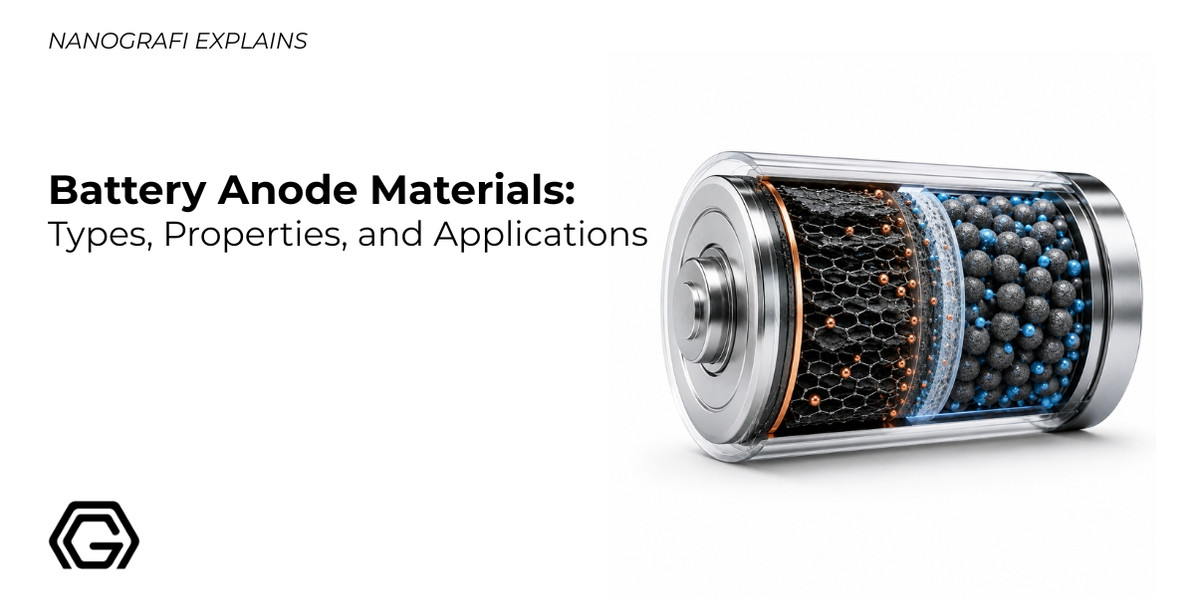
Battery Anode Materials: Types, Properties, and Applications
The anode is the negative electrode of a battery, the component that stores lithium ions while the cell is charged and releases them during discharge to deliver current.
In a lithium-ion cell the anode material sets a hard ceiling on energy density, charging speed, and cycle life, which is why it is one of the most studied components in modern energy storage. This guide explains what anode materials are, the properties that define a good one, the main material families used in 2026, and the applications that depend on each, with references for the key technical claims.
What Is a Battery Anode?
A battery has two electrodes, an anode and a cathode, separated by an electrolyte and a separator. During discharge the anode is oxidized, meaning it gives up electrons to the external circuit, while lithium ions travel through the electrolyte to the cathode. In a graphite anode this works through intercalation, where lithium ions slide between the carbon layers to form the compound LiC6, storing one lithium atom for every six carbon atoms.
A point of terminology often confuses readers: because the labels follow the direction of current, anode and cathode technically swap roles between charge and discharge. The industry resolves this by naming electrodes for their discharge role, so the anode is always the negative electrode and the cathode the positive one. That convention is used throughout this guide. For the partner electrode and the chemistries that pair with the anode, see the companion guide on battery cathode materials.
The basic architecture has not changed since Sony commercialized the first lithium-ion battery in 1991, using a carbon anode and a lithium cobalt oxide cathode, work that earned Goodenough, Whittingham, and Yoshino the 2019 Nobel Prize in Chemistry.
What Makes a Good Anode Material?
No single material wins on every axis. Engineers balance the following properties, and improving one usually costs another.
- High specific capacity. Measured in milliamp hours per gram (mAh/g), this sets how much charge a given mass can store. Graphite is capped at a theoretical 372 mAh/g, while silicon reaches roughly ten times that (RSC EES Batteries, 2026).
- Low, flat working potential. The anode should operate close to the potential of lithium metal so the full cell delivers high voltage. A flat profile also makes the state of charge easier to estimate.
- Good electronic and ionic conductivity. Electrons must reach the current collector and ions must diffuse within the particle. Poor conductivity wastes energy as heat and throttles charging speed.
- Structural stability over cycles. Materials that swell and shrink a lot crack and lose electrical contact. Graphite expands only modestly and survives thousands of cycles, which is a large part of why it still dominates.
- A stable solid electrolyte interphase (SEI). During the first cycles a thin passivating layer forms on the anode. A well behaved SEI protects the surface; an unstable one keeps consuming lithium and capacity.
- Safety, abundance, and cost. A practical anode has to be safe under abuse, available at scale, and affordable, which is why carbon based anodes remain the commercial default.
What Are the Main Types of Anode Materials?
Graphite and Carbon Anodes
Graphite is the workhorse anode of the lithium-ion industry. Lithium intercalates between its layers to form LiC6, delivering a reliable 372 mAh/g with excellent cycle life and a low, flat voltage (Advanced Energy Materials, 2026). It is cheap, abundant, and well understood, so most consumer and automotive cells still rely on it, using natural graphite, synthetic graphite, or a blend.
Several carbon forms improve conductivity or rate capability beyond plain graphite. Conductive additives such as carbon black help electrons reach every active particle, and spherical graphite improves packing density. The role of mesocarbon microbeads in dense, uniform electrodes is covered in the article on mesocarbon microbeads (MCMB) graphite for lithium-ion batteries. For the full set of materials compatible with lithium-ion designs, see the overview of lithium battery materials.
Silicon and Silicon-Composite Anodes
Silicon stores lithium by alloying rather than intercalation, reaching a theoretical capacity of about 3,600 to 4,200 mAh/g because each silicon atom can bind up to 3.75 lithium atoms (Li3.75Si). The catch is volume change: silicon expands by roughly 300 to 400 percent when fully lithiated, which fractures particles and breaks electrical contact, shortening cycle life. Industry manages this with nanostructuring, silicon-carbon composites, and small silicon additions blended into graphite, historically limited to around 10 percent of the anode The engineering trade-offs are detailed in the guides on silicon anode materials for lithium-ion batteries and lithium-silicon batteries.
Lithium Titanate (LTO)
Lithium titanate trades energy for safety and longevity. Its operating potential is higher than graphite, so cell voltage and energy density drop, but in return it barely changes volume during cycling, avoids the troublesome SEI layer, and tolerates very fast charging and wide temperatures. These traits make LTO a favorite where cycle life and safety outrank range, such as grid storage and some transit fleets.
Lithium Metal Anodes
Lithium metal is the ultimate anode by capacity and underpins most next-generation solid-state battery concepts. Plating and stripping lithium directly removes the host material entirely, but it tends to grow dendrites that can short the cell, the central safety problem researchers are tackling with solid electrolytes.
Conversion and Alloy Anodes
Tin, germanium, and various metal oxides and sulfides store lithium through alloying or conversion reactions, offering capacities well above graphite (for example, Li4.4Sn at roughly 993 mAh/g) but suffering the same pulverization from volume change (USPTO patent 8,962,188). Advanced carbon nanomaterials help here as conductive scaffolds: graphene and carbon nanotubes build conductive networks that buffer expansion and speed charge transport, especially in silicon composite electrodes.
Anode Material Comparison
|
Material |
Theoretical capacity |
Key strength |
Main limitation |
|
Graphite |
~372 mAh/g |
Cycle life, low cost, maturity |
Limited energy density |
|
Silicon |
~3,600–4,200 mAh/g |
Very high capacity |
~300–400% volume change |
|
Lithium titanate (LTO) |
~175 mAh/g |
Fast charge, safety, long life |
Low energy density |
|
Lithium metal |
~3,860 mAh/g |
Highest capacity |
Dendrite formation, safety |
|
Tin (alloy) |
~993 mAh/g (Li4.4Sn) |
High capacity |
Pulverization on cycling |
Capacity values are theoretical maxima from the references cited above; practical electrodes deliver less.
Where Are Anode Materials Used?
- Consumer electronics. Phones, laptops, tablets, and wearables overwhelmingly use graphite, increasingly with a few percent of silicon blended in to raise energy density without sacrificing cycle life.
- Electric vehicles. EVs demand high energy for range and durability for years of cycling. Graphite remains standard, and silicon-graphite blends are the main lever automakers use to extend range. The wider materials picture is covered in advanced materials driving the future of electric vehicles.
- Grid and stationary storage. Cycle life and safety outweigh energy density, favoring graphite and lithium titanate. Sodium-ion systems are emerging here with their own anode chemistries, discussed in the guide on anode materials for sodium-ion batteries.
- Aerospace and specialty uses. Weight is critical, so high specific energy anodes and lithium metal research draw strong interest, as outlined in lithium-ion batteries for aerospace applications.
How Is an Electrode Made From Anode Powder?
Active material is only part of a working electrode. The powder is mixed with a conductive additive and a binder into a slurry, coated onto a copper current collector, dried, and pressed. The binder holds everything together; common choices and their behavior are described in the article on the PVDF binder for batteries, while water-based CMC and SBR binders are widely used for graphite. The finished anode is then paired with a cathode, electrolyte, and separator to form a complete cell, a process walked through in the guide to making a lithium-ion coin cell battery.
Conclusion
The anode is where a battery stores its charge, and the material chosen shapes the energy, lifespan, charging speed, and safety of the whole cell. Graphite dominates because it balances capacity, stability, and cost; silicon promises far higher energy if its expansion can be controlled; and lithium titanate and lithium metal serve the extremes of longevity and energy density. As silicon composites and solid-state designs mature, the anode remains one of the most active frontiers in energy storage. To complete the picture of how a cell is built, read the companion guide on battery cathode materials, and explore Nanografi's range of anode materials for research and production.
References
- Royal Swedish Academy of Sciences, The Nobel Prize in Chemistry 2019: Popular Science Background. nobelprize.org
- Argonne National Laboratory, Argonne's debt to the 2019 Nobel Prize for the lithium-ion battery (2019).
- RSC, EES Batteries, "Redox aspects of lithium-ion batteries" (2026), DOI 10.1039/D5EB00202H.
- Li et al., Advanced Energy Materials (2026), "Silicon/Graphite Hybrid Anodes," DOI 10.1002/aenm.202505674.
- Lithium-silicon battery, Wikipedia (accessed 2026).
- USPTO Patent 8,962,188, "Anode compositions for lithium secondary batteries."
Recent Posts
-
What Is Conductive Masterbatch? CNT, Carbon Black and Graphene Compared
A conductive masterbatch is a concentrated blend of a conductive carbon additive and a carrier polym …14th Oct 2026 -

Biomaterials for Implants: Titanium vs Nitinol vs Hydroxyapatite Coatings
Implantable medical devices operate under very different mechanical and biological conditions. A hip …7th Oct 2026 -
CNT Paste vs Silver Paste vs Carbon Paste: Which Conductive Adhesive Should You Use?
Conductive pastes quietly hold much of modern electronics together. They bond chips to substrates, d …1st Oct 2026