
How to Choose the Right Battery Binder: PVDF vs CMC vs SBR vs PTFE
A battery binder makes up only a small share of an electrode, yet it decides whether the coating stays intact, adheres to the current collector and keeps its conductive pathways through hundreds of charge and discharge cycles. Choosing between PVDF, CMC, SBR and PTFE is therefore not a question of which polymer is "best", but of which binder fits the electrode type, the solvent route and the manufacturing process.
This guide explains what a battery binder does, compares the four most widely used binder systems and shows how to match each one to a cathode, an anode or a solvent-free electrode.
What Is a Battery Binder?
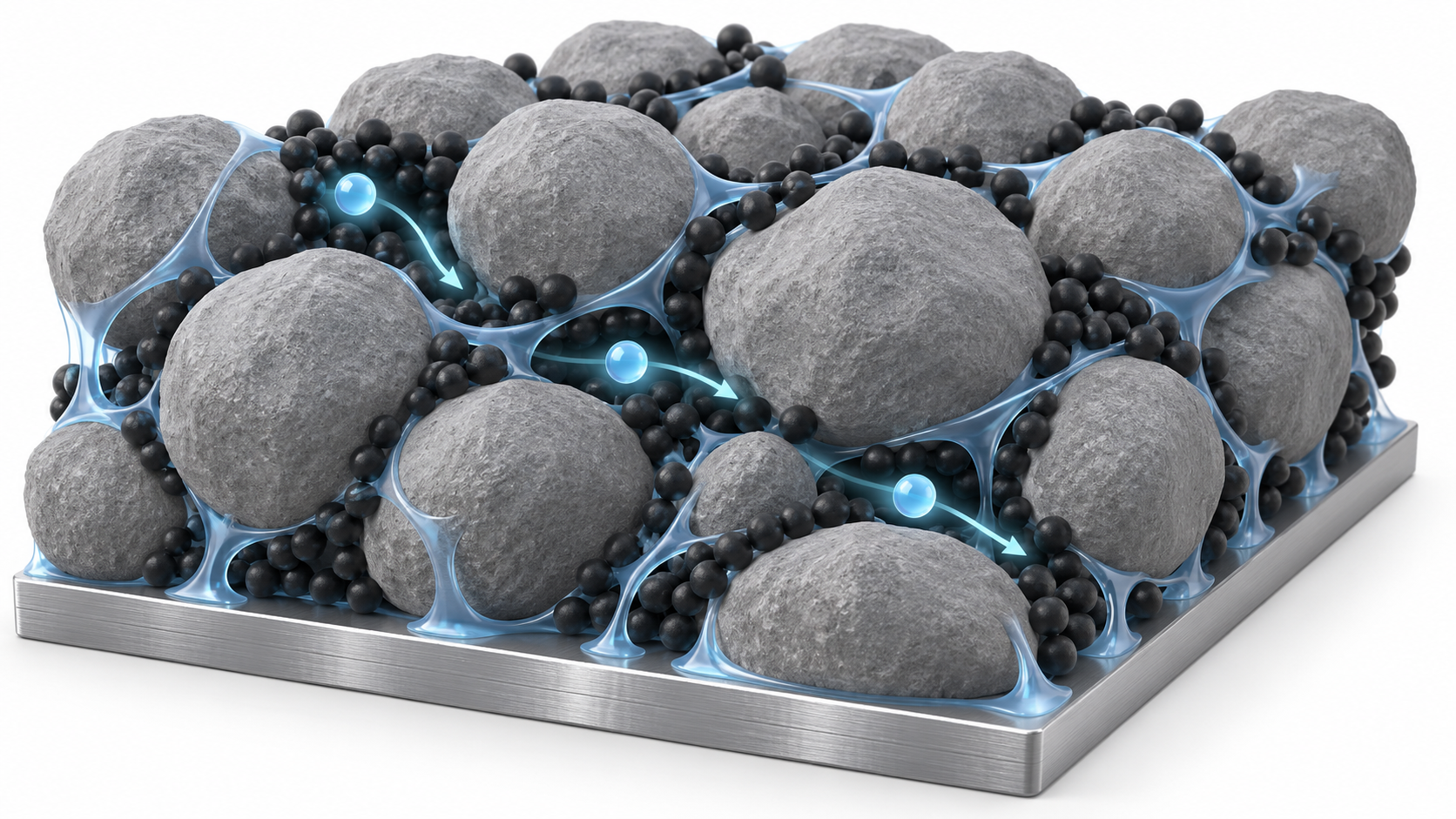
A battery binder is a polymer that holds the active material and the conductive additive together and anchors this composite to the current collector. In a lithium-ion cell, the cathode is usually coated on aluminum foil and the anode on copper foil. The binder is electrochemically inactive in most systems, but it carries several functions at once:
- It helps form a stable, uniform electrode slurry during mixing.
- It provides adhesion between the coating and the current collector, and cohesion between particles.
- It keeps active particles in contact while they expand and contract during lithium insertion and extraction.
- It should be chemically compatible with the electrolyte and sufficiently electrochemically stable over the operating potential range of the electrode.
Binder distribution matters as much as binder chemistry. Too little effective coverage leads to cracking, powdering or delamination. Excess binder can cover active surfaces, increase cell resistance and reduce the share of active material in the electrode.
Cathode and Anode Requirements Are Different
The binder sees very different conditions on each side of the cell. On the cathode side it must resist oxidation at high potentials, which is why fluorinated polymers dominate there. On the anode side it must tolerate reducing conditions and remain compatible with the solid electrolyte interphase (SEI) that forms on graphite. Anodes that contain silicon add a mechanical challenge, because silicon particles change volume strongly during cycling and the binder must keep them connected.
PVDF Binder: The Standard for Lithium-Ion Cathodes
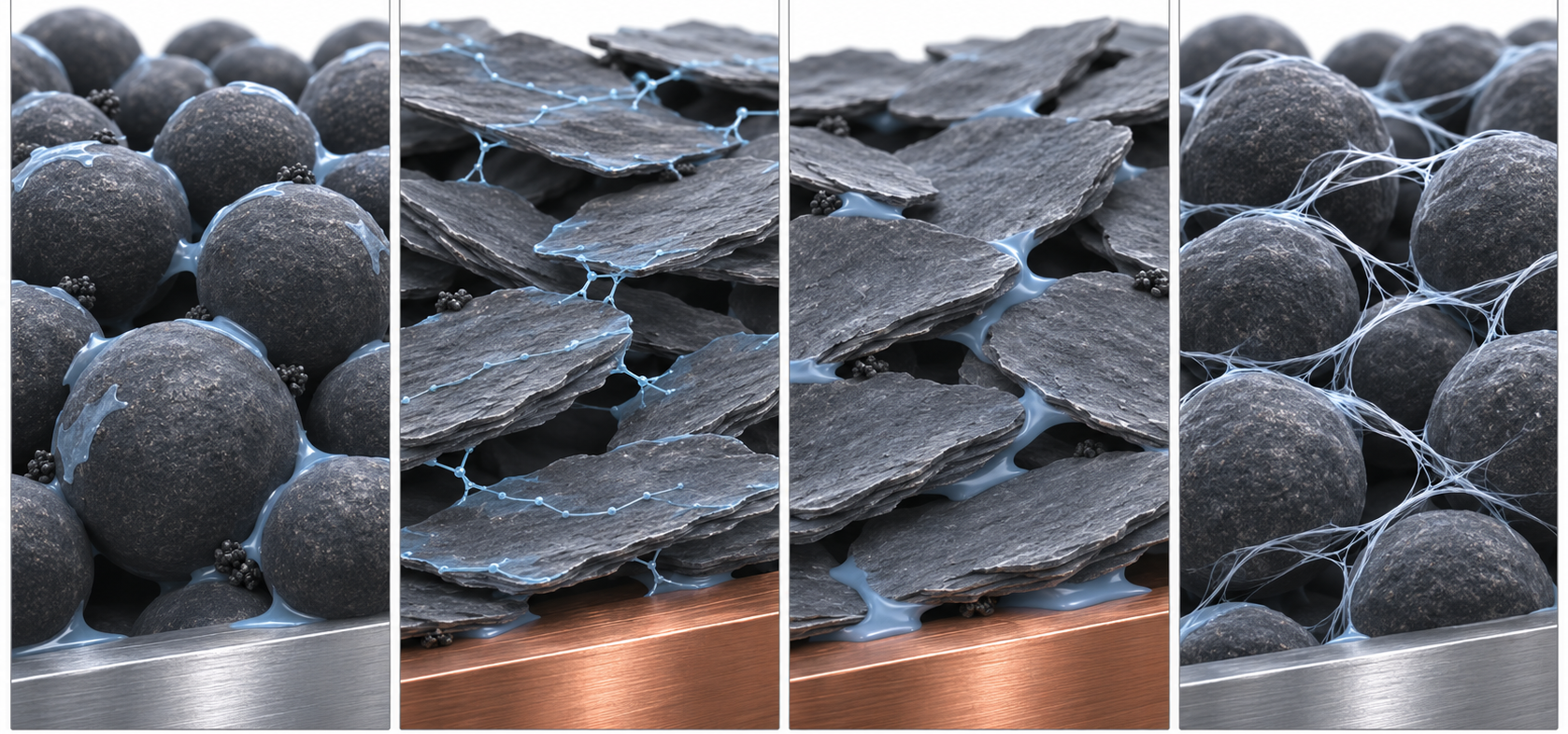
Polyvinylidene fluoride (PVDF) is the reference binder for most lithium-ion cathodes. Its fluorinated structure contributes to chemical stability and oxidation resistance, while adhesion to aluminum depends on the PVDF grade, electrode formulation, foil surface and processing conditions. PVDF is dissolved in N-methyl-2-pyrrolidone (NMP), and this solvent route is well established in slurry mixing, coating and drying lines.
PVDF also has limits. It binds mainly through weak physical interactions, it is neither electronically nor ionically conductive on its own, and PVDF-based cathode formulations generally require conductive additives such as carbon black or carbon nanotubes dispersed in a compatible medium. NMP requires solvent handling, drying energy and recovery systems, which is the main reason the industry keeps developing water-based and dry alternatives.
Nanografi supplies a PVDF binder for Li-ion battery electrodes in an 80 g vacuum-sealed set, intended for mixing with cathode powders.
Key specifications:
|
Property |
Value |
|
Appearance |
White powder |
|
Purity |
≥99.5% |
|
Molecular weight |
600,000 g/mol |
|
Melting point |
160-168 °C |
|
Intrinsic viscosity |
1.0-2.0 dL/g |
|
Rotational viscosity |
≥2000 mPa·s (1 g/10 ml NMP) |
|
Solubility |
Transparent solution in NMP, 30 °C, 1 h |
|
Moisture |
≤0.1% (Karl Fischer) |
CMC Binder: Dispersion and Rheology Control in Water
Sodium carboxymethyl cellulose (Na-CMC), commonly referred to as CMC in battery formulations, is a water-soluble cellulose derivative and the foundation of aqueous anode processing. In the slurry, CMC thickens the water phase, adsorbs onto graphite particles and helps stabilize their dispersion and reduce sedimentation before coating. Its degree of substitution (DS) and molecular weight directly affect slurry viscosity, particle dispersion and adhesion. Research on natural graphite anodes has shown that CMC with a lower DS adsorbs more strongly on graphite and improves dispersion stability.
On its own, a CMC film is relatively stiff and brittle. For this reason CMC is rarely used alone in graphite anodes; it is combined with an elastic latex binder such as SBR.
Nanografi offers carboxymethyl cellulose (CMC) binder as a micron powder (CAS 9004-32-4) for lithium-ion anode research:
|
Property |
Value |
|
Appearance |
White powder |
|
Purity |
≥99.5% |
|
Viscosity (2% aqueous solution) |
7,000-10,000 mPa·s |
|
Degree of substitution |
0.6-0.9 |
|
pH |
6.0-8.5 |
|
Water content |
≤10% |
|
Fe / Pb / As |
≤40 ppm / ≤15 ppm / ≤2 ppm |
SBR Binder: Elasticity and Adhesion for Anodes
Styrene-butadiene rubber (SBR) is supplied as a water-based latex emulsion. Its rubbery polymer particles form flexible bridges between active particles and the copper current collector. Where CMC controls rheology and dispersion, SBR adds elasticity, toughness and adhesion. The combination gives an anode that tolerates calendering, winding and the repeated volume changes of cycling.
SBR is sensitive to processing conditions. High shear, unsuitable pH or contamination can destabilize the latex, and fast drying can drive binder migration toward the coating surface, which weakens adhesion at the foil.
The styrene-butadiene rubber (SBR) binder from Nanografi is a carboxylated SBR emulsion available in 500 ml and 1000 ml packs:
|
Property |
Value |
|
Appearance |
Milky white liquid emulsion |
|
Total solids |
51.3 wt% |
|
Styrene / butadiene |
24-26 wt% / 71-73 wt% |
|
Carboxyl content |
5 wt% |
|
pH |
6-7 |
|
Brookfield viscosity |
159 mPa·s |
|
Glass transition temperature |
-18 °C |
|
Storage temperature |
0-38 °C |
Why CMC and SBR Are Used Together
CMC and SBR solve different problems, so they are treated as one binder system rather than two alternatives. CMC disperses the graphite micron powder and sets the slurry viscosity for coating. SBR adds elasticity and enhances adhesion, complementing CMC’s binding and rheological functions. Their ratio, the order in which they are added and the mixing shear all change coating quality and cycle life. A common practice is to dissolve and fully hydrate CMC first, disperse the active material and conductive additive in it, and add the SBR latex last under low shear.
For silicon-rich anodes based on silicon nanoparticles, CMC/SBR remains a practical starting point, while alternative binders such as polyacrylic acid or sodium alginate, whose functional-group density, distribution and polymer structure can improve interactions with silicon surfaces, are widely studied for higher silicon contents.
PTFE Binder: Fibrillation and Solvent-Free Electrodes
Polytetrafluoroethylene (PTFE) is a fully fluorinated polymer with high thermal stability and chemical resistance, but its electrochemical stability depends on the electrode potential and electrolyte. Its unique property is fibrillation: under controlled shear, PTFE particles stretch into fine fibers that form a web around active particles. This mechanism makes PTFE the leading binder for dry, solvent-free electrode processing and for thick or free-standing electrode films.
PTFE also has drawbacks. It does not dissolve in common solvents, its adhesion to metal foils is weaker than PVDF, and fibril quality depends strongly on mixing energy. Too little mixing gives a weak network, while excessive mixing can break the fibers and damage active particles. PTFE can also be reduced at low potentials, so its stability on the anode side must be checked for each system.
Nanografi's PTFE binder dispersion is a water-based condensed liquid, available in 100 g, 500 g and 1000 g packs.
PVDF vs CMC vs SBR vs PTFE at a Glance
|
Criterion |
PVDF |
CMC |
SBR |
PTFE |
|
Typical electrode |
Cathode |
Anode |
Anode |
Cathode, thick or free-standing films |
|
Processing medium |
NMP |
Water |
Water (latex) |
Water dispersion or dry powder route |
|
Main role |
Adhesion and stability |
Dispersion, viscosity control and particle binding |
Elasticity and adhesion |
Fibrillated mechanical network |
|
Can serve as the sole binder? |
Yes |
Rarely, usually with SBR |
Usually combined with CMC |
Yes, in dry or film processes |
|
Key strength |
High oxidation stability |
Uniform, stable slurries |
Flexibility under volume change |
Solvent-free, high-loading electrodes |
|
Main limitation |
NMP handling and recovery |
Limited flexibility, brittleness depends on formulation |
Latex stability, migration |
Limited foil adhesion, process-sensitive fibrillation and reduction risk at low anode potentials |
How to Choose the Right Battery Binder
- Fix the manufacturing route first. Decide whether the electrode will be NMP-based, water-based or dry processed. Changing the binder often means changing the solvent system, the dryer and the recovery equipment.
- Define the electrode duty. Note whether it is a cathode or an anode, the active material chemistry, particle size, target loading, porosity and expected volume change. The choice of cathode materials or anode materials narrows the binder options immediately.
- Match binder to electrode potential and chemistry. Fluorinated binders are commonly used in cathodes, but their stability must be verified at the intended upper cutoff potential and with the selected electrolyte. CMC/SBR suits graphite and silicon-graphite anodes. Aqueous cathode processing is possible but requires checks for active-material compatibility with water, slurry pH, residual moisture and aluminum corrosion.
- Screen a formulation window, not one recipe. Vary binder ratio, solids content, mixing order and drying conditions one at a time, then compare slurry rheology, coating uniformity and peel strength.
- Validate in cells. Build representative cells with coin cell materials and track formation efficiency, impedance, rate capability and capacity retention before scaling up.
Frequently Asked Questions
What is the most common binder for lithium-ion cathodes?
PVDF dissolved in NMP is the most widely used cathode binder because of its stability at high potentials and its adhesion to aluminum foil.
Can CMC be used without SBR?
CMC can serve as the sole binder, but coating flexibility and resistance to cracking depend on the CMC grade, electrode formulation and processing conditions. In graphite anodes it is normally combined with SBR to add elasticity and adhesion.
Is PTFE a direct replacement for PVDF?
No. PTFE works through fibrillation rather than dissolution, so it requires a process designed for it, typically dry mixing, film formation and calendering.
Which binder is best for silicon anodes?
There is no single answer. CMC/SBR is a practical baseline, and alternative binders such as polyacrylic acid and sodium alginate, whose functional-group density, distribution and polymer structure can improve silicon–binder interactions are often studied for higher silicon contents. Each system needs electrode and cell-level validation.
Conclusion
PVDF remains a widely established binder for NMP-processed cathodes, CMC and SBR together form a standard water-based binder system for graphite-based anodes, and PTFE opens the way to solvent-free and thick electrode designs. The right battery binder is the one that matches the electrode chemistry, the solvent route and the process window of the production line. Explore Nanografi's battery materials and battery lab machines to build a complete electrode formulation, or contact the Nanografi team for larger quantities and technical support.
References / Kaynaklar
- Lestriez, B. Functions of polymers in composite electrodes of lithium ion batteries. Comptes Rendus Chimie 13 (2010) 1341-1350. doi:10.1016/j.crci.2010.01.018
- Lee, J.-H. et al. Effect of carboxymethyl cellulose on aqueous processing of natural graphite negative electrodes and their electrochemical performance for lithium batteries. Journal of The Electrochemical Society 152 (2005) A1763-A1769. doi:10.1149/1.1979214
- Grillet, A. M. et al. Conductivity degradation of polyvinylidene fluoride composite binder during cycling: measurements and simulations for lithium-ion batteries. Journal of The Electrochemical Society (2016). doi:10.1149/2.0341609jes
- Kovalenko, I. et al. A major constituent of brown algae for use in high-capacity Li-ion batteries. Science 334 (2011) 75-79. doi:10.1126/science.1209150
- Deng, L. et al. Design criteria for silicon-based anode binders in half and full cells. Advanced Energy Materials (2022). doi:10.1002/aenm.202200850
- Chen, B. et al. Polymeric binders used in lithium ion batteries: actualities, strategies and trends. ChemElectroChem (2024). doi:10.1002/celc.202300651
- Srivastava, M. et al. Binders for Li-ion battery technologies and beyond: a comprehensive review. Batteries 10 (2024) 268. doi:10.3390/batteries10080268
- Lv, M. et al. Binder design strategies for cathode materials in advanced secondary batteries. Energy & Environmental Science (2024). doi:10.1039/D4EE00791C
- Oak Ridge National Laboratory. Dry-processed PTFE cathode manufacturing study (2024), OSTI. osti.gov/servlets/purl/2448552
Recent Posts
-
How to Choose the Right Battery Binder: PVDF vs CMC vs SBR vs PTFE
A battery binder makes up only a small share of an electrode, yet it decides whether the coating sta …5th Nov 2026 -

Advanced Materials for Humanoid Robots: Actuators, Sensors and E-Skin
Humanoid robots are leaving the lab. They now walk warehouse floors, handle parts on assembly lines …23rd Oct 2026 -
What Is Conductive Masterbatch? CNT, Carbon Black and Graphene Compared
A conductive masterbatch is a concentrated blend of a conductive carbon additive and a carrier polym …14th Oct 2026