
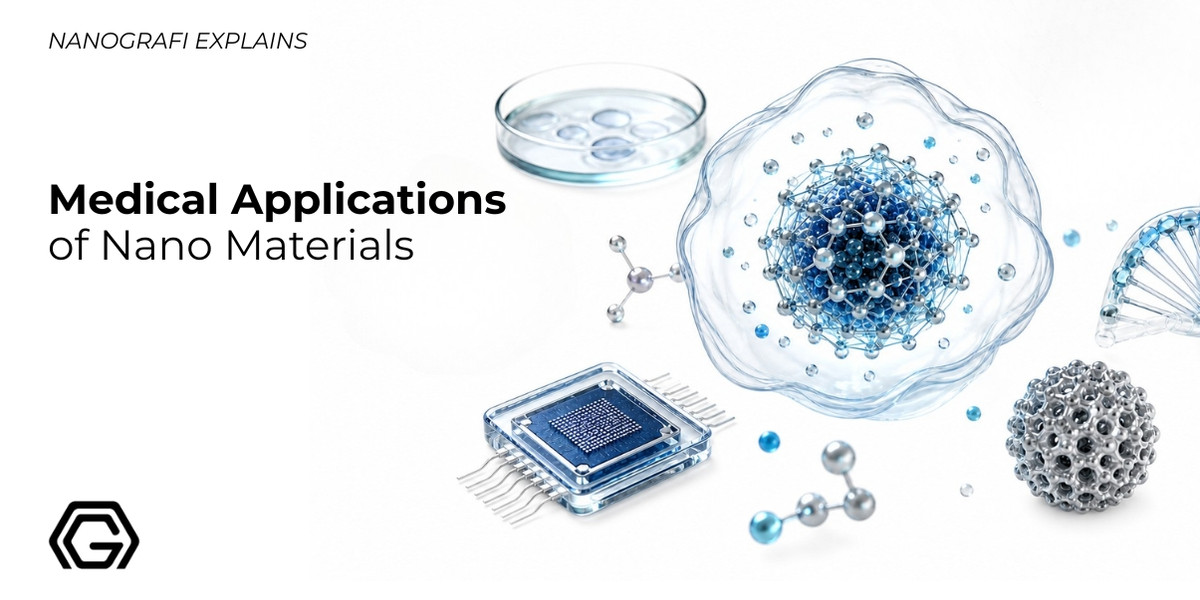
Medical Applications of Nano Materials
Medicine has advanced enormously over the past few decades, and nanotechnology has been one of the quiet engines behind that progress. Because nanomaterials are so small, often thousands of times thinner than a human hair, they can travel through the body, reach individual cells, and carry out tasks that conventional medicines and tools cannot.
This matters because many traditional treatments work bluntly. A chemotherapy drug, for example, attacks healthy cells along with cancerous ones. Nanomaterials offer a more precise alternative: they can be engineered to find diseased tissue, deliver treatment exactly there, and leave the rest of the body largely untouched.
This guide explains, in plain language, the main ways nanomaterials are used in medicine today and where the field is heading next.
Disclaimer: The content of this post or any other linked material is intended for informational purposes only and should not be taken as medical advice.

How Nanomaterials Work in the Body
The usefulness of a nanomaterial comes from its size and its surface. At the nanoscale, materials behave differently than they do in bulk, with unique magnetic, optical, and chemical properties that medicine can take advantage of.
To work safely inside the body, a nanoparticle usually has to meet a few basic requirements. It needs to stay stable in the body's physiological environment, avoid triggering a harmful immune response, and not be toxic. For this reason, nanoparticles are often coated with a biocompatible material. That coating does two jobs at once: it makes the particle safer and more stable, and it provides a surface where useful molecules, such as antibodies or drugs, can be attached for each specific task.
This ability to "decorate" a nanoparticle with targeting molecules is what makes precision medicine possible.
Targeted Drug Delivery
Drug delivery is the most developed and widely used application of nanomedicine.
The idea is to package a drug inside a nanoscale carrier that protects it as it travels through the body, then releases it at the right place and the right time. Polymer-based carriers, for instance, hold the drug within a matrix of polymer chains; as the matrix slowly degrades, it releases the medicine directly at the site of action.
Several types of carrier are used in the clinic and in research:
- Liposomes, tiny fatty bubbles that can carry drugs inside them. Doxil, a liposome-based cancer drug approved in 1995, was the first nanomedicine of its kind.
- Lipid nanoparticles (LNPs), the technology that delivered mRNA in COVID-19 vaccines and is now being applied to cancer vaccines and gene therapies.
- Polymeric nanoparticles and dendrimers, which offer controlled, gradual release.
- Gold nanoparticles and carbon nanotubes, which can carry drugs while also allowing the delivery to be tracked.
The biggest advantage is targeting. By engineering a nanoparticle to recognize markers on diseased cells, doctors can deliver a drug straight to a tumor, reducing side effects and improving the chance that the treatment works. This same approach is now being explored for hard-to-reach areas like the brain, where nanoparticles may help carry drugs across the protective blood-brain barrier to treat neurodegenerative diseases.
Better Medical Imaging and Diagnostics
The second major use of nanomaterials is helping doctors see and detect disease earlier and more clearly.
Certain nanoparticles act as contrast agents, making scans sharper and more informative. Iron oxide (magnetic) nanoparticles, for example, can create local magnetic effects that improve the contrast in MRI scans, helping to reveal problems that might otherwise be missed. Gold nanoparticles and fluorescent quantum dots are widely used in diagnostics and imaging because of their distinctive optical behavior.
Nanoparticles are also extraordinarily good at detection. Because their surfaces can be attached to specific antibodies or DNA strands, they can pick up even faint traces of a disease marker, enabling diagnosis far earlier than traditional methods. This makes them ideal building blocks for biosensors, devices that can flag disease at its earliest, most treatable stage.
A growing trend combines these abilities with treatment in a single particle, an approach called theranostics (therapy plus diagnostics). A theranostic nanoparticle can treat a disease and let doctors watch, in real time, how well the treatment is working.
Tissue Repair and Regenerative Medicine
Nanomaterials are also helping the body heal itself.
In tissue engineering, nanofibers are used to build tiny scaffolds that give cells a structure to grow on. These scaffolds encourage cells to multiply and can support the repair of damaged tissue, which is especially valuable for patients with chronic wounds or injuries that are slow to heal. Hydroxyapatite nanoparticles, a material closely related to natural bone mineral, are widely used in bone repair and dental applications because the body accepts them readily.
Researchers are also developing "smart" wound dressings built from nanofibers, some with built-in sensors that monitor the wound's environment and actively promote healing.
Antibacterial and Protective Uses
Some nanomaterials fight infection directly. Silver nanoparticles are well known for their antibacterial properties and are used in wound dressings, coatings for medical instruments, and surfaces in healthcare settings where preventing infection is critical. Zinc oxide nanoparticles are similarly used for their antimicrobial and protective effects.
What's Next for Nanomedicine
The field is moving quickly, and a few directions stand out:
- Gene therapy and gene editing. Lipid nanoparticles are being used to deliver gene-editing tools (such as CRISPR components) that could one day correct genetic diseases at their source.
- Cancer vaccines. The same mRNA-LNP technology behind COVID-19 vaccines is being adapted to train the immune system against tumors.
- Smart, responsive carriers. Nanoparticles that release their cargo only when they sense a specific trigger, such as the acidic environment around a tumor, are making treatment even more precise.
- AI-assisted design. Artificial intelligence is increasingly used to design and optimize nanoparticles, speeding up the search for safer, more effective formulations.
The main challenges that remain are scaling up manufacturing, ensuring long-term safety, and making these advanced treatments widely and affordably available.

Conclusion
Nanomaterials have quietly become one of medicine's most powerful tools. They deliver drugs with precision, sharpen the images doctors rely on, detect disease earlier than ever, fight infection, and help damaged tissue heal. With proven successes already in clinics worldwide and a deep pipeline of new therapies in development, nanomedicine is no longer a future promise. It is a present-day reality that continues to grow.
Explore the nanomaterials used in biomedical research: browse Nanografi's nanoparticle range, including gold nanoparticles, iron oxide nanoparticles, silver nanoparticles, and quantum dots.
Read More on Blografi: Applications of Graphene in Medicine
Frequently Asked Questions
What are nanomaterials used for in medicine? Nanomaterials are mainly used for targeted drug delivery, improved medical imaging and diagnostics, fighting infection, and repairing tissue. Their small size lets them interact directly with cells, making treatments more precise and diagnoses earlier.
Are nanomaterials safe to use in the human body? Nanomaterials designed for medical use must be stable in the body, non-toxic, and unlikely to trigger a harmful immune response. They are usually coated with a biocompatible material to improve safety. Many nanomedicines are already approved and used in clinics worldwide, though safety testing remains a key part of developing any new treatment.
What is the most famous example of a medical nanomaterial? The lipid nanoparticles used to deliver mRNA in COVID-19 vaccines are the most widely known example. The first approved nanomedicine, however, was Doxil, a liposome-based cancer drug approved in 1995.
What is theranostics? Theranostics combines therapy and diagnostics in a single nanoparticle. It allows doctors to treat a disease and monitor how well the treatment is working at the same time.
How do nanoparticles deliver drugs to a specific place? A nanoparticle's surface can be attached to targeting molecules, such as antibodies, that recognize markers on diseased cells. This lets the particle carry its drug directly to a tumor or affected tissue, sparing healthy cells and reducing side effects.
References
- Barahona, I. F., Herranz, F., & Ruiz-Cabello, J. (2020). Applications of Nanoparticles in Biomedical Imaging. Spanish National Center for Cardiovascular Research (CNIC).
- Moreira, A. F. (2022). Nanomaterials in Drug Delivery Applications. Nanomaterials, 12(20), 3565. https://doi.org/10.3390/nano12203565
- Barenholz, Y. (2012). Doxil, the First FDA-Approved Nano-Drug: Lessons Learned. Journal of Controlled Release, 160(2), 117–134.
- Chow, J. C. L. (2022). Application of Nanomaterials in Biomedical Imaging and Cancer Therapy. Nanomaterials, 12(5), 726. https://doi.org/10.3390/nano12050726
- Zhang, et al. (2025). Principles of Lipid Nanoparticle Design for mRNA Delivery. BMEMat (Wiley). https://doi.org/10.1002/bmm2.12116
- Basnet, C. A. (2025). Nanomedicine in 2025: Current Trends and Future Prospects. Journal of Recent Advances in Nanomedicine and Nanotechnology, 1(3).
- Frontiers in Medical Technology (2025). Nanoparticles: A New Frontier in Neurodegenerative Disease Therapy. Volume 7. https://doi.org/10.3389/fmedt.2025.1654003
- Molla, A. (2025). Lipid Nanoparticles in Drug Delivery: Advances, Challenges, and Clinical Prospects. Journal of Drug Design and Medicinal Chemistry, 11(3), 48–54.
Recent Posts
-
Graphene Dispersion vs CNT Dispersion: Use Cases and How to Choose
If you have ever tried to formulate a conductive ink, a battery slurry, or an anti-static coating, y …16th Jul 2026 -

The 10 Strongest Advanced Materials of All Time (2026 Guide)
The phrase "strongest material" is more ambiguous than it first appears. In materials science, mecha …7th Jul 2026 -
How to Choose the Right Nanoparticles for Your Research
Selecting the right nanoparticles is one of the most consequential decisions a researcher can make. …23rd Jun 2026