
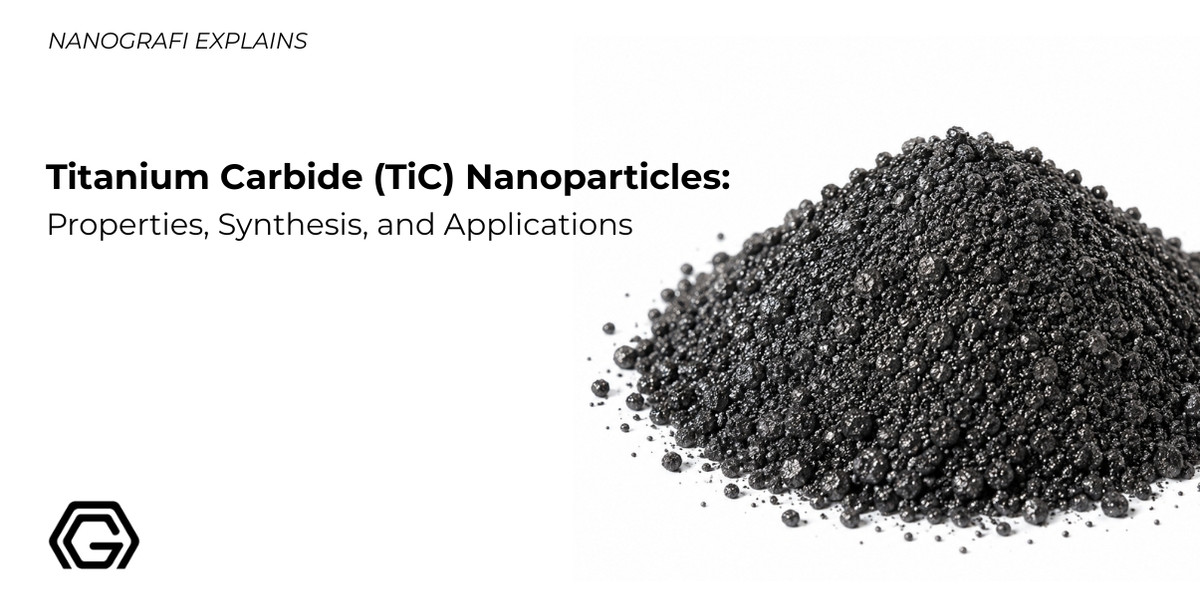
Titanium Carbide (TiC) Nanoparticles: Properties, Synthesis, and Applications
Titanium carbide (TiC) is an extremely hard refractory ceramic, the only carbide in the titanium–carbon system, with a hardness of 9 to 9.5 on the Mohs scale that rivals tungsten carbide.
In nanoparticle form, below 100 nanometers, its large specific surface area and high purity make it more reactive and more effective across coatings, cutting tools, and emerging energy and electronics applications. This guide explains what titanium carbide nanoparticles are, their structure and properties, how they are synthesized, and where they are used, with references for the key technical data.
What Are Titanium Carbide Nanoparticles?
Titanium carbide is a binary compound of titanium and carbon with the chemical formula TiC, appearing as a light gray to black powder with a metallic luster. It belongs to the family of interstitial transition metal carbides, the same group as tungsten carbide (WC) and tantalum carbide (TaC), and is prized for a rare combination of high hardness, high melting point, wear resistance, and good electrical conductivity.
A nanoparticle is a particle smaller than 100 nanometers, where one nanometer is one billionth of a meter. At this scale TiC gains a much larger surface-area-to-volume ratio, which sharpens its catalytic, mechanical, and coating behavior compared with bulk powder. Titanium carbide nanoparticles typically offer high purity, narrow particle size distribution, high wear resistance, and good conductivity.
A Brief History of Titanium Carbide
Titanium carbide production began in the 1920s, when manufacturers of incandescent light bulbs searched for a cheaper alternative to tungsten filament technology. Because the raw material, titanium dioxide, was inexpensive, a method for producing cemented carbide based on TiC emerged. The William Lawrence Voelker–designed Crawford-Voelker lamp, held by the National Museum of American History, used a titanium-carbide filament from this era.
The material matured over the following decades. Around 1970 titanium nitride additions raised the toughness of cemented compounds, while chromium and nickel additives improved corrosion resistance. In the 1980s, sintering powder under uniform compression improved material quality, and sintered carbide powders are now standard wherever resistance to temperature, wear, and oxidation is required.
Properties of Titanium Carbide Nanoparticles
Physical and Thermal Properties
Titanium carbide is defined by extreme thermal and mechanical stability. Its melting point is approximately 3,140 °C and its boiling point about 4,820 °C, with a molecular weight of 59.89 g/mol and a density near 4.93 g/cm³. Notably, TiC also becomes superconducting at very low temperature, around 1.1 K.
Hardness and Wear Resistance
With a Mohs hardness of 9 to 9.5, titanium carbide is among the hardest of the transition metal carbides, second only to materials like diamond in its class. Combined with low friction, this makes it an excellent coating for drills, dies, punches, and mills. Because pure TiC is brittle, it is usually added at 5 to 30 percent by weight to tungsten-based cemented carbides to raise hardness and high-temperature cutting performance rather than used alone.
Lubricating and Chemical Properties
Atomic force microscopy comparisons have shown titanium carbide to have lower frictional response than both titanium nitride and vinyl chloride, with the added advantage that its friction does not depend strongly on the counterface material. Chemically, TiC nanoparticles are very stable: practically insoluble in water, resistant to hydrochloric and sulfuric acids, but soluble in nitric acid, aqua regia, and nitric–hydrofluoric mixtures. Above roughly 800 °C it begins to oxidize in air, reacting at high temperature to form titanium oxide and titanium nitride.
Storage
Because humidity affects diffusion performance, TiC nanopowder should be vacuum-sealed and stored in a cool, dry environment away from air and mechanical tension.
What Is the Structure of Titanium Carbide?
Titanium carbide crystallizes in a face-centered cubic (FCC) structure with a lattice constant of about 432.8 pm, the same sodium chloride (rock salt) structure adopted by titanium nitride (TiN) and zirconium nitride (ZrN). It is frequently non-stoichiometric, with very homogeneous samples obtained between TiC₀.₅ and TiC₀.₉₈, where some carbon positions remain vacant. This vacancy tolerance is why TiC is classified as an interstitial metal carbide, and it allows TiC, TiN, and TiO to form continuous solid solutions with one another.
How Are Titanium Carbide Nanoparticles Synthesized?
Titanium carbide can be produced through several routes, each suited to different purity and particle-size targets. The most common industrial method reacts titanium dioxide with carbon (charcoal) at high temperature:
- Carbothermal reduction: TiO₂ + 3C → TiC + 2CO (around 1,800 to 2,000 °C)
- Direct synthesis from elements: Ti + C → TiC
- Methane as carbon source: Ti + CH₄ → TiC + 2H₂
- Chemical vapor deposition (CVD): TiCl₄ + CH₄ → TiC + 4HCl, using volatile titanium tetrachloride
- Mixed-carbide solid solutions for tooling: TiO₂ + WC + 3C → TiC + 2CO
For nanoscale and submicron particles, gas-phase reactions of titanium halides with hydrogen and methane are particularly useful, since they give fine control over particle size. Among related synthesis and coating routes, chemical vapor deposition is the dominant industrial technique for applying TiC layers.
What Are the Applications of Titanium Carbide Nanoparticles?
Cutting Tools and Wear-Resistant Coatings
The largest use of TiC is in cutting tools. It is added to tungsten-based cemented carbides to harden drills, dies, punches, and mills, and tungsten-free tool bits can be made by combining TiC nanoparticles with molybdenum carbide and nickel in a cermet matrix. CVD-applied TiC coatings, deposited at around 1,000 °C and reaching thicknesses up to 9 μm, give high adhesion and a large wear reserve for metal-forming tools. These roles overlap with the broader field of advanced coatings for corrosion and wear resistance.
Cermets and Hard Alloys
TiC is a foundational component of cermets and tungsten-free hard alloys, where its hardness and heat resistance improve abrasive steel bearings, pipes, and cutting tools. It also serves as an alloy additive and as an essential ingredient in sintered ferrotitanium.
Aerospace and High-Temperature Components
Thanks to its extreme melting point and thermal-shock resistance, TiC is used in heat-shield coatings for spacecraft atmospheric reentry, heat-resistant electrodes for industrial arc lamps, combustion-plant screens, thermocouple housings, and crucibles for handling molten metals. The wider role of nanomaterials in this sector is covered in the role of nanotechnology in aerospace.
Electrodes and Electrolysis
In electrolysis, TiC functions as an electrode paired with a mercury cathode, and TiC electrodes used in underwater electro-autogenous cutting of steel consume 6 to 10 times less material than conventional electrodes. TiC nanoparticles are also used to coat the graphite electrodes of electric arc furnaces.
The MXene Connection: Ti₃C₂Tₓ
One of the most significant modern developments is the use of titanium carbide as the parent material for MXenes, a family of two-dimensional transition metal carbides discovered in 2011. Titanium carbide MXene (Ti₃C₂Tₓ) is by far the most studied member, valued for its high electrical conductivity, hydrophilicity, and large interlayer spacing (Chemistry of Materials, ACS). It is produced by selectively etching the aluminum layer from a MAX phase precursor, a process explored in the guide on MXenes from MAX phases.
Ti₃C₂Tₓ has rapidly become a leading material for energy storage, electromagnetic interference (EMI) shielding, water purification, electrocatalysis, gas sensing, and biomedicine. Its role in next-generation batteries and supercapacitors links directly to the broader rise of MXene in advanced energy storage systems, and the comparison of MXene vs. graphene is one of the most active debates in 2D materials today.
Titanium Carbide Nanoparticles at a Glance
|
Property |
Value |
|---|---|
|
Chemical formula |
TiC |
|
Molecular weight |
59.89 g/mol |
|
Crystal structure |
Face-centered cubic (NaCl type) |
|
Lattice constant |
~432.8 pm |
|
Melting point |
~3,140 °C |
|
Boiling point |
~4,820 °C |
|
Density |
~4.93 g/cm³ |
|
Mohs hardness |
9–9.5 |
|
Color |
Light gray to black |
|
Particle size (nano) |
< 100 nm |
Values compiled from the references cited above.
Conclusion
Titanium carbide nanoparticles combine extreme hardness, a very high melting point, wear resistance, and electrical conductivity in one material, which is why TiC has been central to cutting tools, cermets, and high-temperature coatings for a century. The nanoscale form sharpens these properties and opens newer roles in electrodes and aerospace, while titanium carbide MXene (Ti₃C₂Tₓ) has pushed the material to the frontier of energy storage, EMI shielding, and 2D electronics. As both hard-coating and 2D-material research advance, titanium carbide remains one of the most versatile ceramics in modern materials science. Explore Nanografi's range of titanium carbide nanoparticles for research and industrial use.
References
- ScienceDirect Topics, "Titanium Carbide – an overview," Elsevier (accessed 2026).
- ChemicalBook, "Titanium carbide, CAS 12070-08-5," physical property data.
- Nanotrun, "Titanium carbide and titanium carbide ceramics" (technical data sheet).
- Anasori, Gogotsi et al., Chemistry of Materials, "Guidelines for Synthesis and Processing of Two-Dimensional Titanium Carbide (Ti₃C₂Tₓ MXene)" (2017), DOI 10.1021/acs.chemmater.7b02847.
- Oyehan et al., ACS Applied Energy Materials, "Recent Advances in Titanium Carbide MXene (Ti₃C₂Tₓ) Cathode Material" (2022), DOI 10.1021/acsaem.2c01845.
Recent Posts
-

CNT Paste vs Silver Paste vs Carbon Paste: Which Conductive Adhesive Should You Use?
Conductive pastes quietly hold much of modern electronics together. They bond chips to substrates, d …1st Oct 2026 -
ZnO Nanoparticles in OLED and Perovskite Solar Cells
Many printed solar cells and inverted display stacks need a layer that collects electrons and passes …23rd Sep 2026 -

MXene for EMI Shielding: Materials, Mechanisms and Applications
Electromagnetic interference has become a design constraint rather than an afterthought. Densely pac …10th Sep 2026