
Types of Fullerenes and Their Specific Uses (C60, C70, Fullerenols)
Introduction
Carbon is a versatile element that occurs naturally in several allotropic forms, such as diamond and graphite. In 1985 a new member joined this family: fullerenes, hollow cage-like carbon molecules built entirely from pentagonal and hexagonal faces. Notable for their symmetric, soccer-ball-like architecture, these molecules opened a new field of research in chemistry, materials science, and nanotechnology from the moment they were discovered. Today, fullerenes find applications across a wide spectrum, from solar cells to drug-delivery systems and from antioxidant therapies to energy storage. This guide explains the structure, chemical behavior, and current applications of the three most widely known types of fullerene, namely C60, C70, and fullerenols, drawing on verified scientific sources.
What Is a Fullerene?
Fullerenes are an allotrope of carbon alongside graphite and diamond. They are hollow, cage-like molecules made up only of pentagonal and hexagonal faces. Mathematically, every closed fullerene contains exactly 12 pentagons and a variable number of hexagons, a direct consequence of Euler's polyhedron formula (V − E + F = 2).
Fullerenes take their name from Richard Buckminster Fuller (1895 to 1983), the American architect and inventor known for his geodesic domes. Because the molecules resemble these domes, they are also nicknamed "buckyballs."
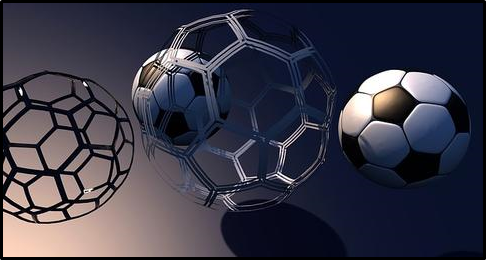
The structure of the C60 is similar to that of a soccer ball.
The Discovery of Fullerenes and the Nobel Prize
Fullerenes were discovered in 1985 at Rice University by Harold Kroto, Robert Curl, Richard Smalley, and team members James R. Heath and Sean O'Brien, during experiments that vaporized graphite with a laser in a helium atmosphere.
For this discovery, the 1996 Nobel Prize in Chemistry was awarded jointly to Robert F. Curl Jr., Sir Harold W. Kroto, and Richard E. Smalley. Contrary to a common misconception, the award ceremony took place not in October but on December 10, 1996, the 100th anniversary of Alfred Nobel's death.
C60 Fullerene (Buckminsterfullerene)
C60 fullerene is made up of 60 carbon atoms and is the most commonly found fullerene; it often occurs naturally in soot.
Structure of C60
The structure of C60 resembles a soccer ball and is geometrically a truncated icosahedron:
- 60 vertices, each holding a carbon atom
- 32 faces: 12 pentagons and 20 hexagons
- Each pentagon is surrounded by five hexagons; no two pentagons are ever adjacent (the Isolated Pentagon Rule)
- Van der Waals diameter of approximately 1.1 nm
Each carbon atom bonds to three neighbors using sp2 orbitals. The fourth valence electron sits in a p orbital perpendicular to the spherical surface; the overlap of these p orbitals gives the molecule a benzene-like delocalized electron system.
Bond Types in C60
The carbon atoms in C60 are equivalent (as in benzene), but the bonds are not. There are two types of bonds:
|
Bond type |
Location |
Length |
Character |
|---|---|---|---|
|
6:6 bond |
Between two hexagons |
~0.139 nm (1.39 Å) |
Shorter, resembles a double bond |
|
6:5 bond |
Between a pentagon and a hexagon |
~0.143 nm (1.43 Å) |
Longer, resembles a single bond |
For this reason, most addition reactions occur across the shorter 6:6 bond. C60 cannot undergo substitution reactions because it has no hydrogen atoms.
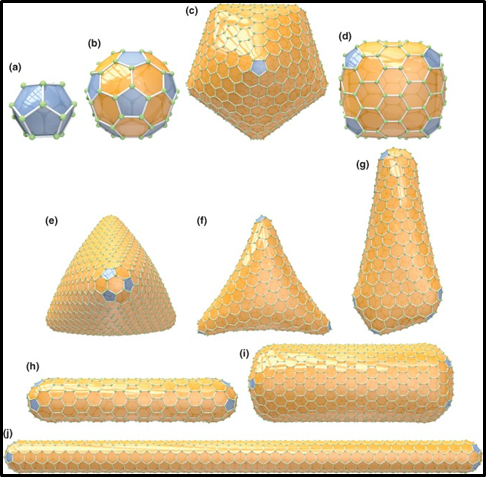
(a) C20-Ih, (b) C60-Ih, and (c) C960-Ih (DP = 12 × 1); barrel shaped, for example, (d) C140-D3h (DP = 6 × 2); trigonal pyramidally shaped (tetrahedral structures), for example, (e) C1140-Td (DP = 4 × 3); (f) trihedrally shaped C440-D3 (DP = 3 × 4); (g) nano-cone or menhir C524-C1 (DP = 5 + 7 × 1); cylindrically shaped (nanotubes), for example, (h) C360-D5h, (i) C1152-D6d, (j) C840-D5d (DP = 2 × 6). Click Image for Source
Applications of C60
C60 is one of the most studied fullerenes, and the broader range of applications of fullerenes continues to expand across industry and research:
- Energy storage: Electrode additive in lithium-based battery and supercapacitor research
- Organic electronics: Semiconductor and photovoltaic (solar cell) materials
- Materials science: Additive in high-pressure synthetic diamond production
- Polymers and composites: New polymer types and durable coatings
- Pharmaceutical chemistry: Drug-delivery systems and novel pharmaceuticals
- Coating technology: Additive in fire-retardant paints

C70 Fullerene
C70 fullerene is made up of 70 carbon atoms and is the second most common fullerene after C60. It has an elongated spheroidal (ellipsoidal) structure that resembles a rugby ball.
Structure of C70
- 70 carbon atoms, D5h symmetry
- 37 faces: 25 hexagons and 12 pentagons
- A carbon atom at each vertex and a bond along each edge
- Its structure is similar to C60 but includes an added belt of 5 hexagons at the equator
Properties of C70
In solid form, C70 is a dark-brown granular powder; when sublimed, it forms needle-like crystals up to 5 mm long that are dark blue-black in color. Its greater curvature compared with C60 makes it more chemically reactive and less symmetrical, giving it a more complex electronic structure. Because of the weak delocalization of its electrons, it is not "super-aromatic" and behaves like an electron-deficient alkene.
Applications of C70
- Organic photovoltaics (OPV): More efficient than C60 in solar cells that require high optical absorption
- Organic semiconductors: Used as an n-channel semiconductor in transistor applications
- Antioxidant applications: Rapid reaction with free radicals
- Catalysis: Catalyst in various chemical reactions
- Water purification and biohazard protection
- Portable power and medical applications
Fullerenols (Water-Soluble Fullerenes)
Fullerenols are water-soluble fullerene derivatives obtained by adding hydroxyl (–OH) groups to C60 fullerene. Because of their ability to scavenge free radicals, they are also called "radical sponges."
Properties of Fullerenols
- They retain the same hollow spherical structure as fullerenes
- They show strong antioxidant properties thanks to the delocalized pi bonds in their cages
- Their water solubility opens the door to biological and medical applications
- When excited by UV or visible light, they can enter a reactive triplet state and react rapidly with oxygen or biomolecules (photosensitization)
Applications of Fullerenols
- Medical imaging: Their spherical structure makes them useful carriers for contrast agents, drugs, and radiopharmaceuticals
- Oncology: Cytotoxic agents in the diagnosis of tumor cells and protective in healthy cells; used in chemotherapy and radiobiology
- Neurodegenerative diseases: Protection against oxidative damage by scavenging free radicals in brain tissue
- Organ protection: Reduction of oxidative stress during transplantation in experimental studies
- Lung protection: Protective agent against oxidative damage
Note: Although fullerenols have many promising applications, scientific knowledge about their mechanisms of action and potential side effects remains limited. Medical applications are largely still at the research stage. For a deeper look at how these molecules are being studied in healthcare, see this comprehensive review of fullerene applications in biomedicine.

Other Types of Fullerenes
While C60, C70, and fullerenols are the best-known types, the fullerene family is far broader. Many different structures can be built from pentagons and hexagons; however, every closed fullerene must contain exactly 12 pentagons, while the number of hexagons can vary.
The smallest fullerene is C20. C20 is a dodecahedron made up of 12 pentagons and no hexagons. Because of its extreme curvature, it has high internal strain and strong reactivity.
Other fullerene forms include structures such as C24, C28, C32, C44, C50, C70, C76, C84, C240, C540, and C960. Among these, C60 and C70 are the most common; the others are quite rare.
An interesting fact: In 2010, NASA's Spitzer telescope detected the spectral signatures of C60 and C70 in a cloud of cosmic dust surrounding a star 6,500 light-years away. This confirmed that fullerenes occur naturally in space.
Frequently Asked Questions
What does a fullerene look like? C60 resembles a soccer ball and C70 resembles a rugby ball. Both are hollow, cage-like carbon molecules.
What is the main difference between C60 and C70? C60 has 60 carbon atoms and 32 faces (a soccer ball), while C70 has 70 carbon atoms and 37 faces (a rugby ball). C70 is more reactive and less symmetrical.
Why are fullerenes important? As the third known form of carbon, they opened a new field of research in nanotechnology, electronics, energy, and medicine. They also paved the way for the development of carbon nanotubes.
Who discovered fullerenes? They were discovered in 1985 by Harold Kroto, Robert Curl, and Richard Smalley (together with team members Heath and O'Brien). Kroto, Curl, and Smalley shared the 1996 Nobel Prize in Chemistry.
Conclusion
Fullerenes, especially C60, C70, and fullerenols, are a versatile form of carbon with a wide range of applications spanning electronics to medicine. The soccer-ball structure of C60, the rugby-ball shape of C70, and the water-soluble antioxidant properties of fullerenols make these materials a cornerstone of modern nanotechnology. Researchers continue to discover new applications for these unique molecules.
References (APA)
American Chemical Society. (n.d.). Discovery of fullerenes: National Historic Chemical Landmark. https://www.acs.org/education/whatischemistry/landmarks/fullerenes.html
Encyclopaedia Britannica. (2026). Sir Harold W. Kroto. https://www.britannica.com/biography/Harold-Kroto
Encyclopaedia Britannica. (2026). Richard E. Smalley. https://www.britannica.com/biography/Richard-Smalley
Nobel Prize Outreach. (1996). The Nobel Prize in Chemistry 1996. https://www.nobelprize.org/prizes/chemistry/1996/summary/
Schwerdtfeger, P., Wirz, L. N., & Avery, J. (2015). The topology of fullerenes. WIREs Computational Molecular Science, 5(1), 96–145. https://doi.org/10.1002/wcms.1207
Wikipedia. (2026). C70 fullerene. https://en.wikipedia.org/wiki/C70_fullerene
Wikipedia. (2026). Fullerene. https://en.wikipedia.org/wiki/Fullerene
Recent Posts
-

MXene for EMI Shielding: Materials, Mechanisms and Applications
Electromagnetic interference has become a design constraint rather than an afterthought. Densely pac …10th Sep 2026 -
Handling and Storage Best Practices for Metal Oxide Nanopowders
A metal oxide nanopowder is bought for a property that a coarse powder cannot deliver: a specific su …1st Sep 2026 -

Activated Carbon vs Zeolites vs MOFs: Which Adsorbent Material Should You Choose?
Activated carbon, zeolites and metal-organic frameworks (MOFs) represent three distinct adsorbent cl …20th Aug 2026