
What Is Conductive Masterbatch? CNT, Carbon Black and Graphene Compared
A conductive masterbatch is a concentrated blend of a conductive carbon additive and a carrier polymer, supplied as pellets and diluted into the base resin during injection molding, extrusion or film blowing. It is the most widely used route for turning an insulating plastic into an antistatic, static dissipative or electrically conductive part without handling fine carbon powders on the production floor.
Three additive families dominate this field: conductive carbon black, carbon nanotubes (CNT) and graphene nanoplatelets (GNP). All three can reach the same resistance target, but they need very different loadings to get there. That difference drives melt flow behavior, mechanical performance, surface quality and final part cost. This article explains how each additive works in a polymer and how to choose the right one for your application.
How a Conductive Masterbatch Works
A masterbatch carries the conductive additive at a high concentration in a carrier resin that is compatible with the final polymer, such as PP, PE, PA, PC or ABS. The converter adds it to the base resin at a defined let-down ratio, and the ratio sets the final additive content in the part.
The two-step approach exists because carbon additives are difficult to disperse. Producing the concentrate on a twin-screw compounder under controlled shear breaks up agglomerates. The dilution step then distributes and further disperses the pre-dispersed additive through the base resin. Melt mixing studies on polycarbonate and polypropylene have shown that masterbatch dilution is a practical and reproducible route to good nanotube dispersion.
For the plant, the advantages are just as important: no free nanopowder on the line, accurate gravimetric dosing and more consistent batch-to-batch results.
Percolation: Why Conductivity Appears Suddenly
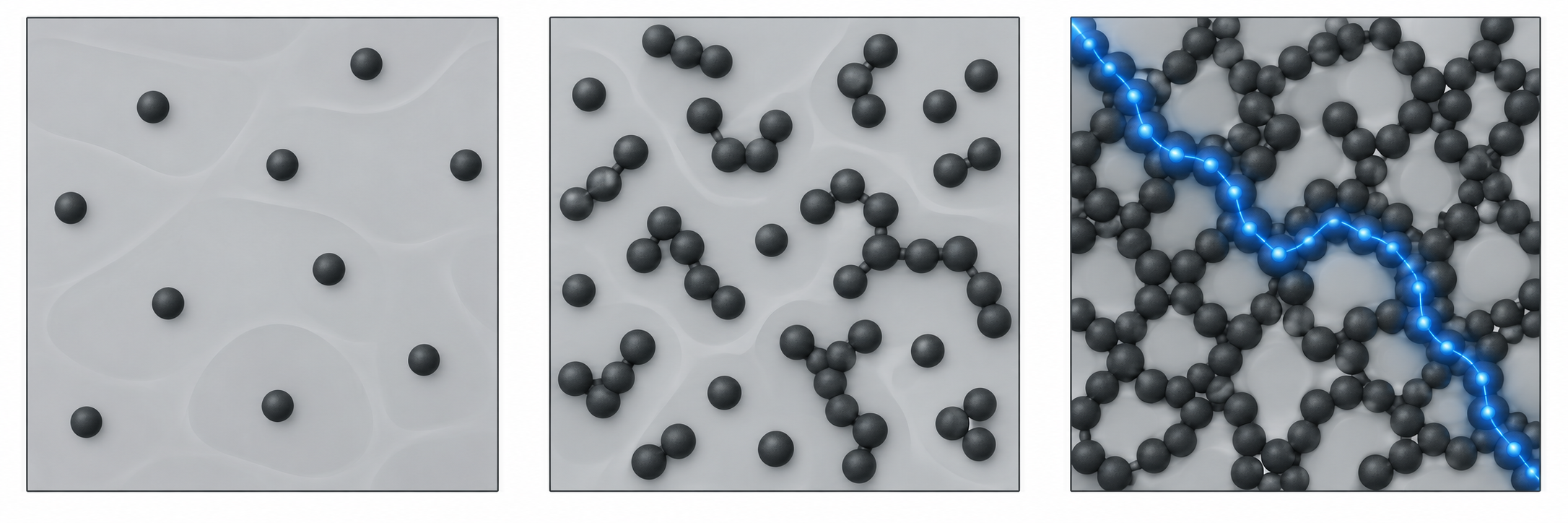
A filled plastic stays insulating until the conductive particles form a continuous network, either by direct contact or by coming close enough for electrons to tunnel between them. The loading at which this network first forms is called the percolation threshold. Around this point, resistivity drops by several orders of magnitude over a narrow loading window.
The threshold is not a fixed material constant. It depends on particle geometry, the state of dispersion, the polymer and the processing history. High aspect ratio fillers such as nanotubes and well-exfoliated graphene can build a network at much lower loadings than the compact aggregates of carbon black. In a landmark study, graphene sheets in polystyrene reached percolation at about 0.1 volume percent.
Close to the threshold, small changes in dispersion or dosing cause large swings in resistance. For this reason, industrial formulations are set safely above the threshold rather than at its edge.
Resistance Classes for ESD Plastics
Before choosing an additive, define the resistance class the part must meet. The packaging standard ANSI/ESD S541 uses the following ranges for surface resistivity classification, measured as surface resistance according to ANSI/ESD STM11.11:
|
Class |
Surface resistance (ohms) |
Typical use |
|
Conductive |
Less than 1.0 x 10⁴ |
Shielding packaging, grounding parts, fuel and powder handling |
|
Static dissipative |
1.0 x 10⁴ to less than 1.0 x 10¹¹ |
Trays, carriers, housings and work surfaces for electronics |
|
Insulative |
1.0 x 10¹¹ or higher |
Standard plastics, not suitable for ESD protection |
Many datasheets express the same idea as surface resistivity in ohms per square and use the term antistatic for the upper part of the dissipative range. Always confirm which standard and test method your customer specifies.
Carbon Black
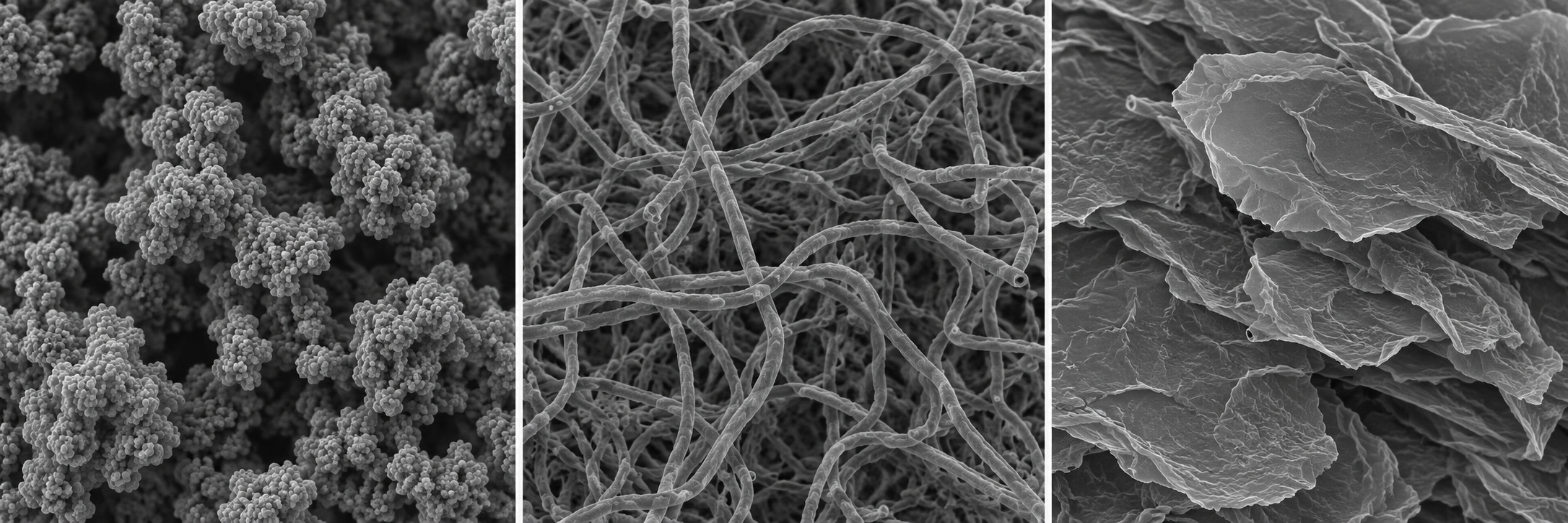
Conductive carbon black is the most established and most economical option. Its conductivity depends strongly on particle size, aggregate structure and surface chemistry. High-structure grades such as Ketjenblack EC-600JD build a network at lower loadings than standard grades, while grades such as Vulcan XC72 offer a balanced cost-performance profile.
The main limitation is the loading. Compared with nanotubes, carbon black typically needs considerably higher additive content to reach the same class. This raises melt viscosity, reduces impact strength and elongation at break, and limits the part to black. Carbon black remains the logical choice for packaging, pipes, cable compounds and industrial parts where cost per part leads the decision. For background on grades and properties, see our carbon black guide.
Carbon Nanotubes (MWCNT)
Multi-walled carbon nanotubes have diameters in the nanometer range and lengths in the micrometer range. This high aspect ratio lets them form a conductive network at a fraction of the carbon black loading. Lower loading means better retention of melt flow rate and mechanical properties, which matters in thin-wall injection molding and in parts with tight dimensional tolerances. Nanotube networks also contribute to electromagnetic interference (EMI) shielding through absorption and reflection.
The trade-offs are a higher price per kilogram and a strong dependence on dispersion. Poorly dispersed nanotubes waste their potential, which is exactly why the masterbatch route is preferred. Industrial grade MWCNTs are the standard choice for compounding. The differences between single-walled and multi-walled types are covered in our SWCNT vs MWCNT comparison.
Graphene Nanoplatelets (GNP)
Graphene nanoplatelets are stacks of a few to several graphene layers with large lateral dimensions. Besides electrical conductivity, they can improve thermal conductivity, gas barrier performance and stiffness in the same part. This makes them attractive for multifunctional components.
Their performance depends heavily on platelet thickness, lateral size and how well they disperse and exfoliate during compounding. In melt processing, platelets tend to restack, so the very low percolation levels reported for solution-processed laboratory samples are harder to reach on an industrial extruder. Grade selection and processing therefore deserve careful testing. Explore our graphene nanoplatelets and the comparison of GNP and graphene oxide for composites.
Side-by-Side Comparison
|
Property |
Carbon black |
MWCNT |
Graphene nanoplatelets |
|
Loading needed for ESD |
High |
Low |
Low to medium, grade dependent |
|
Effect on melt flow |
Strong viscosity increase |
Moderate |
Moderate |
|
Mechanical property retention |
Reduced at high loading |
Good |
Higher stiffness, lower elongation at break |
|
Color |
Black only |
Dark gray to black, lower pigment load |
Gray to black |
|
Additive price per kg |
Low |
High |
Medium |
|
Additional functions |
Pigmentation |
EMI shielding support |
Thermal conductivity, gas barrier |
|
Best fit |
Cost-driven packaging and industrial parts |
Thin-wall, precision and cleanroom parts |
Multifunctional parts |
The comparison is qualitative. Actual values depend on the grade, the polymer, the processing method and the target resistance class.
Hybrid Systems: Carbon Black and CNT Together
Combining two fillers is a growing strategy. Nanotubes can bridge carbon black aggregates and complete the network at a lower total loading, which helps keep melt viscosity under control and retain mechanical properties. A recent study on polyamide 6 showed that a synergistic nanotube and carbon black ratio outperformed both single-filler systems. Ready-made blends such as conductive carbon black and CNT mix shorten formulation development.

How to Choose the Right Additive
- Define the target resistivity range and the test standard first.
- Check the polymer and the process. Thin-wall injection molding and fine films favor low loadings.
- List mechanical requirements such as impact strength and elongation at break.
- Consider color and surface finish requirements.
- Compare cost per finished part, not cost per kilogram of additive.
- Validate with let-down trials and measure resistance on finished parts. The same compound can show very different resistance in a compression-molded plaque and in an injection-molded or printed part.
Nanografi Materials for Conductive Masterbatch Development
Nanografi supplies the conductive carbon additives used by masterbatch and compound producers:
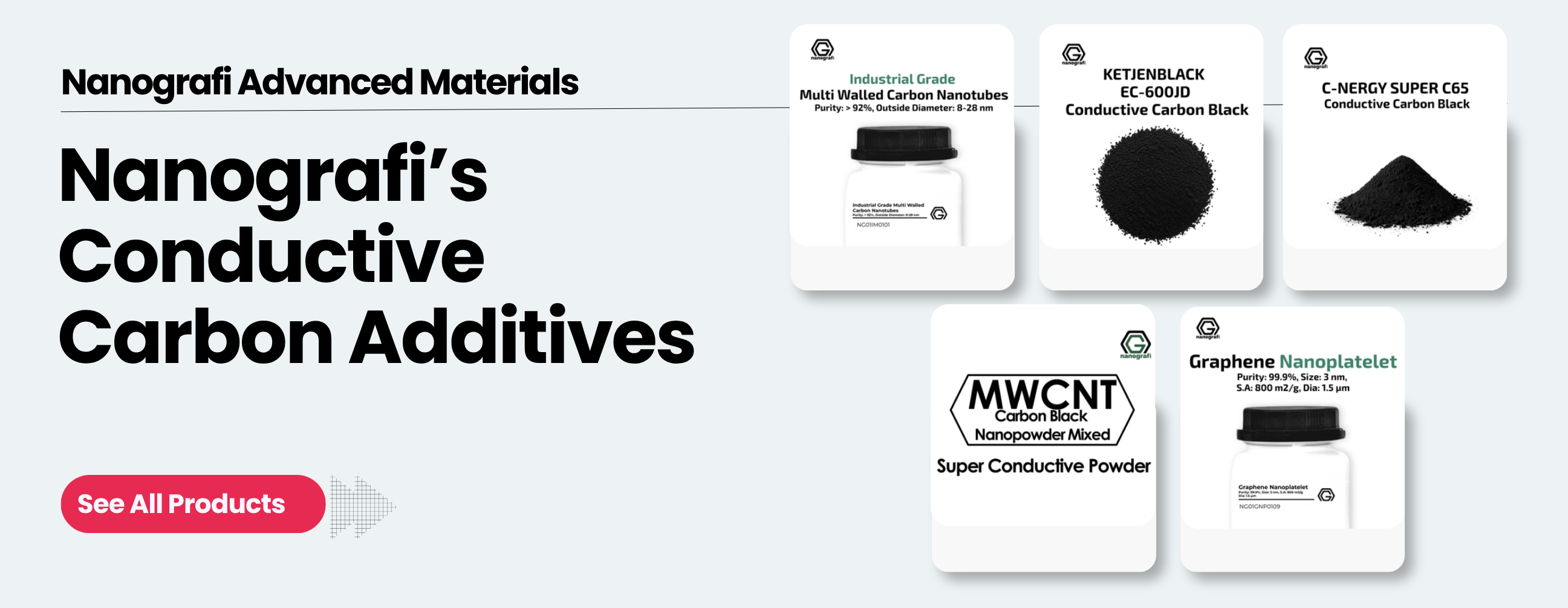
- Industrial grade MWCNT, 8 to 28 nm outer diameter
- Ketjenblack EC-600JD conductive carbon black
- C-NERGY Super C65 conductive carbon black
- Conductive carbon black and CNT mix
- Graphene nanoplatelets
Custom Conductive Masterbatch Development at Nanografi
Based on your target electrical and mechanical performance requirements, base polymer matrix and the other additives in your system, we develop formulations and produce tailored conductive masterbatches specifically designed for your application.
Each project starts from your part specification rather than from a fixed catalog product. The work typically covers the following steps:
- Defining the target surface resistivity range and the test method together with you
- Selecting the conductive additive or hybrid combination for your matrix polymer
- Checking compatibility with the other additives in your system
- Developing the formulation, producing the masterbatch at the agreed additive content
- Recommending a let-down ratio suited to your production conditions
This approach takes you from a target specification to a production-ready masterbatch without having to build the formulation in-house.
Our technical team can assist you in selecting the right additives, optimizing formulations and achieving your target resistivity range. Contact us at sales@nanografi.com for technical data, sample requests and custom masterbatch projects.
Frequently Asked Questions
What is the difference between antistatic and conductive masterbatch?
They differ in the resistance range they target. A conductive masterbatch brings the part below 1.0 x 10⁴ ohms surface resistance, while an antistatic or dissipative masterbatch targets the higher range up to 1.0 x 10¹¹ ohms. Some antistatic masterbatches use migrating chemical additives instead of carbon, which work through surface moisture and are less permanent.
Why use a masterbatch instead of adding CNT powder directly?
Nanotubes agglomerate strongly and are difficult to disperse in a single pass. A masterbatch is produced under controlled shear, so the additive arrives pre-dispersed. It also removes nanopowder handling from the production line and enables accurate dosing.
How much masterbatch do I need?
The let-down ratio depends on the additive concentration in the masterbatch, the polymer and the target resistance class. The right ratio is found through trials, measuring resistance on parts produced under real process conditions.
Can graphene replace carbon black in conductive plastics?
It can in some applications, especially when thermal conductivity or barrier performance is also required. For purely electrical targets at the lowest cost, carbon black or CNT is usually the more predictable choice in melt processing.
References
- Bauhofer, W., Kovacs, J. Z. (2009). A review and analysis of electrical percolation in carbon nanotube polymer composites. Composites Science and Technology, 69(10), 1486-1498. https://doi.org/10.1016/j.compscitech.2008.06.018
- Pötschke, P., Bhattacharyya, A. R., Janke, A. (2004). Melt mixing of polycarbonate with multiwalled carbon nanotubes: microscopic studies on the state of dispersion. European Polymer Journal, 40(1), 137-148. https://doi.org/10.1016/j.eurpolymj.2003.08.008
- Prashantha, K., Soulestin, J., Lacrampe, M. F., Krawczak, P., et al. (2009). Masterbatch-based multi-walled carbon nanotube filled polypropylene nanocomposites: Assessment of rheological and mechanical properties. Composites Science and Technology, 69(11-12), 1756-1763. https://doi.org/10.1016/j.compscitech.2008.10.005
- Stankovich, S., Dikin, D. A., Dommett, G. H. B., Kohlhaas, K. M., et al. (2006). Graphene-based composite materials. Nature, 442, 282-286. https://doi.org/10.1038/nature04969
- Kim, H., Abdala, A. A., Macosko, C. W. (2010). Graphene/polymer nanocomposites. Macromolecules, 43(16), 6515-6530. https://doi.org/10.1021/ma100572e
- Kuilla, T., Bhadra, S., Yao, D., Kim, N. H., et al. (2010). Recent advances in graphene based polymer composites. Progress in Polymer Science, 35(11), 1350-1375. https://doi.org/10.1016/j.progpolymsci.2010.07.005
- Huang, J.-C. (2002). Carbon black filled conducting polymers and polymer blends. Advances in Polymer Technology, 21(4), 299-313. https://doi.org/10.1002/adv.10025
- Al-Saleh, M. H., Sundararaj, U. (2009). Electromagnetic interference shielding mechanisms of CNT/polymer composites. Carbon, 47(7), 1738-1746. https://doi.org/10.1016/j.carbon.2009.02.030
- Kaplan, M. (2026). Synergistic effects of hybrid single-walled carbon nanotube/carbon black fillers in 3D-printable polyamide 6 nanocomposites: Balancing electrical conductivity and mechanical performance. Polymer Engineering & Science, 66(1), 364-377. https://doi.org/10.1002/pen.70217
- ESD Association. ANSI/ESD S541: Packaging Materials for ESD Sensitive Items. ESD Association, Rome, NY.
Recent Posts
-
What Is Conductive Masterbatch? CNT, Carbon Black and Graphene Compared
A conductive masterbatch is a concentrated blend of a conductive carbon additive and a carrier polym …14th Oct 2026 -

Biomaterials for Implants: Titanium vs Nitinol vs Hydroxyapatite Coatings
Implantable medical devices operate under very different mechanical and biological conditions. A hip …7th Oct 2026 -
CNT Paste vs Silver Paste vs Carbon Paste: Which Conductive Adhesive Should You Use?
Conductive pastes quietly hold much of modern electronics together. They bond chips to substrates, d …1st Oct 2026