
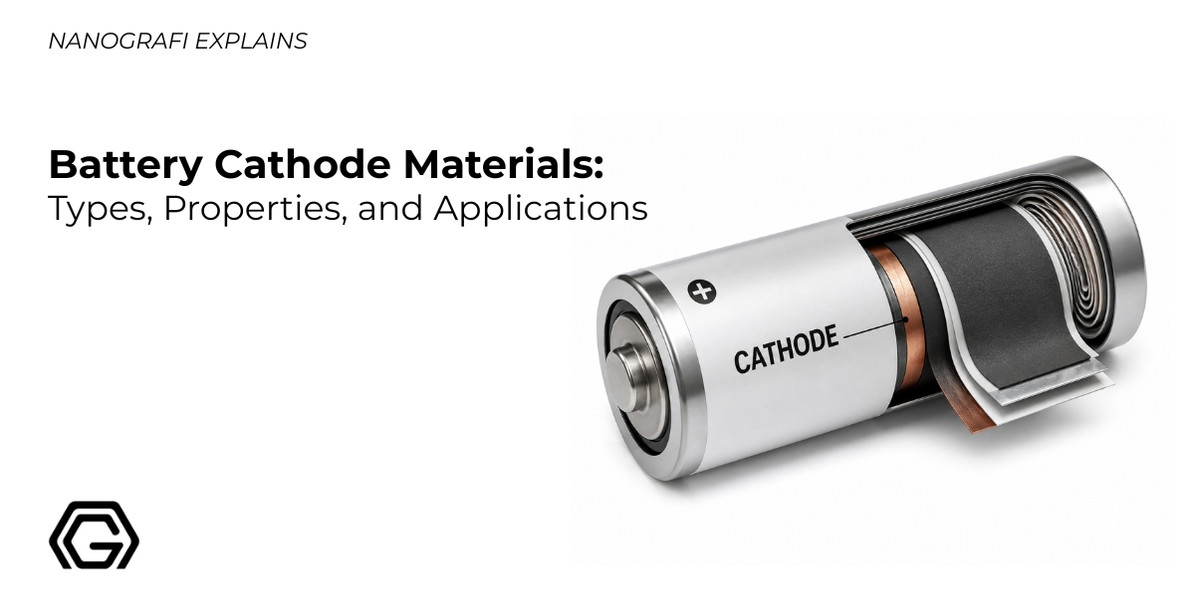
Battery Cathode Materials: Types, Properties, and Applications
The cathode is the positive electrode of a battery and the component that most defines its performance, setting the cell voltage, supplying most of the energy density, and typically accounting for the largest share of cell cost.
In a lithium-ion battery the choice of cathode chemistry decides whether a cell prioritizes range, safety, power, or price. This guide explains what cathode materials are, the properties that make a good one, the main chemistries used in 2026, and the applications each one serves, with references for the key technical claims.
What Is a Battery Cathode?
A battery has two electrodes, an anode and a cathode, separated by an electrolyte and a separator. During discharge the cathode is the positive electrode, the side that accepts lithium ions and electrons and therefore undergoes reduction, the gain of electrons. The transition metal ions inside the cathode change oxidation state to balance the lithium and electrons arriving during discharge, and the process reverses on charge. This back-and-forth shuttling of lithium between electrodes, often called the rocking-chair mechanism, is what makes a lithium-ion battery rechargeable.
One point is worth correcting because it is widely muddled: on discharge the cathode is reduced (gains electrons) while the anode is oxidized (loses electrons). Oxidation is the loss of electrons and reduction the gain, so the cathode is the site of reduction during discharge, not oxidation. Because the labels follow current direction, the roles swap on charge, but the industry names electrodes for their discharge role, the convention used here. For the partner electrode, see the companion article on battery anode materials.
The first commercial cathode, lithium cobalt oxide, was developed by John Goodenough in 1980 and reached the market in Sony's 1991 lithium-ion battery, work recognized by the 2019 Nobel Prize in Chemistry (IEEE Spectrum).
What Makes a Good Cathode Material?
Most real chemistries are a compromise across the following properties.
- High working voltage. The cathode operates at a high potential against lithium, which largely sets the cell voltage. Higher voltage means more energy for the same charge.
- High specific capacity. Measured in mAh/g, this reflects how much lithium the structure can reversibly store. LFP sits near 170 mAh/g while nickel-rich oxides reach roughly 190 to 200 mAh/g.
- Structural stability. The host lattice must take lithium in and out thousands of times without collapsing or shedding oxygen, which underpins both cycle life and safety.
- Adequate conductivity. Many cathode oxides and phosphates conduct electrons poorly, so they are carbon-coated or blended with conductive additives. LFP in particular relies on a carbon coating to perform.
- Thermal and chemical stability. The cathode should stay stable at elevated temperature and resist reacting with the electrolyte, because cathode breakdown is a common trigger for thermal runaway.
- Cost and resource availability. Cobalt is expensive and raises sourcing concerns, so much of cathode development aims to cut cobalt while preserving performance.
What Are the Main Types of Cathode Materials?
Lithium Cobalt Oxide (LCO)
The original commercial cathode, LCO delivers high energy density and a high, stable voltage (nominal ~3.85 V, specific capacity above 160 mAh/g), which suits phones and laptops where volume is tight. Its drawbacks are cost, limited thermal stability, and full reliance on cobalt, so it is rarely used in large packs.
Lithium Iron Phosphate (LFP)
LFP trades energy density for excellent safety, long cycle life, and low cost. Its stable olivine structure resists thermal runaway and contains no cobalt or nickel, with a nominal voltage around 3.2 to 3.3 V and a theoretical capacity near 170 mAh/g. Because LFP conducts poorly, it is almost always paired with a conductive carbon black coating.
Lithium Manganese Oxide (LMO)
LMO uses a spinel structure that supports high power and good safety at low cost, with a specific capacity around 110 to 148 mAh/g. It handles high currents well, suiting power tools and some hybrids, though its high-temperature cycle life is a weakness, so it is often blended with other chemistries.
Lithium Nickel Manganese Cobalt Oxide (NMC)
NMC is the dominant EV cathode because it balances energy, power, and cost. Tuning the nickel-manganese-cobalt ratio tailors the material, and modern nickel-rich grades such as NMC 811 deliver above 180 mAh/g. Higher nickel raises energy density but reduces stability, the central trade-off in cathode engineering today. The shift toward nickel-rich, low-cobalt chemistries is examined in the article on NMC and lithium batteries.
Lithium Nickel Cobalt Aluminum Oxide (NCA)
NCA delivers very high energy density and good power, which is why it appears in long-range EVs and space applications, with a gravimetric capacity around 200 mAh/g. The aluminum is electrochemically inactive but stabilizes the structure at high states of charge, letting NCA push nickel content above 80 percent at the cost of a tighter safety margin. Its role is covered in lithium nickel cobalt aluminum oxide (NCA) in lithium-ion battery applications.
Emerging and Sodium-Ion Cathodes
Research continues on high-voltage spinels, lithium-rich layered oxides, manganese-rich LMFP, and sodium-ion cathodes that avoid lithium entirely. Sodium-ion is advancing fastest for stationary storage, where cost matters more than weight; its electrode chemistry is detailed in the guide on cathode materials for sodium-ion batteries. Conductive additives such as graphene and carbon nanotubes are studied across all of these to improve conductivity and rate capability.
Cathode Chemistry Comparison
| Chemistry | Nominal voltage | Specific capacity | Best for | Main limitation |
|---|---|---|---|---|
| LCO | ~3.85 V | >160 mAh/g | Consumer electronics | Cost, safety, cobalt |
| LFP | ~3.2–3.3 V | ~170 mAh/g | Safety, low cost, long life | Lower energy density |
| LMO | ~3.7 V | ~110–148 mAh/g | High power, low cost | Poor high-temp life |
| NMC | ~3.6–3.7 V | ~180–200 mAh/g | EV range and balance | Tighter safety than LFP |
| NCA | ~3.6 V | ~200 mAh/g | Long-range EVs | Safety, thermal management |
Values are representative of commercial cells from the references cited above.
Where Are Cathode Materials Used?
- Consumer electronics. Phones, laptops, and cameras lean on LCO and NMC for high energy density in a small volume.
- Electric vehicles. This is where cathode choice is most visible: NMC and NCA serve long-range models, while LFP has surged in standard-range and commercial vehicles thanks to safety and low cost. The broader context is covered in advanced materials driving the future of electric vehicles.
- Grid and stationary storage. Long cycle life, safety, and cost dominate, strongly favoring LFP and increasingly sodium-ion systems.
- Power tools and high-power uses. Applications needing current bursts favor LMO and blended chemistries that prioritize power over maximum energy.
How Is an Electrode Made From Cathode Powder?
A cathode is made by mixing the active powder with a conductive additive and a binder into a slurry, coating it onto an aluminum current collector, drying, and pressing. The conductive carbon is essential because most cathode materials conduct electrons poorly on their own. The binder bonds the coating to the foil; the most common choice is described in the article on the PVDF binder for batteries, and the solvent that carries it is covered in the piece on NMP solvent for lithium batteries. The finished cathode is then paired with an anode, electrolyte, and separator into a full cell, a workflow shown in the guide to making a lithium-ion coin cell battery.
Conclusion
The cathode shapes a battery's voltage, energy density, safety, and cost more than any other component, which is why so much battery innovation centers on it. LCO still serves small electronics, LFP wins where safety and cost lead, and NMC and NCA power the electric vehicles that need range, while sodium-ion cathodes open a lower-cost path for stationary storage. To see how the other half of the cell works and which materials pair with these cathodes, read the companion guide on battery anode materials, and explore Nanografi's range of cathode materials for research and production.
References
- Xie & Lu, Nature Communications (2020), "A retrospective on lithium-ion batteries," DOI 10.1038/s41467-020-16259-9.
- IEEE Spectrum, "Remembering Lithium-Ion Battery Pioneer John Goodenough" (2023).
- MDPI, Batteries 7(3):51 (2021), "Comparative Study of Equivalent Circuit Models: LFP, NMC, LMO, NCA."
- EVreporter, "Analysis of Electrodes of Lithium-ion Cells" (2024).
- Himax Electronics, "LFP vs NMC vs NCA: A Technical Comparison of Cathode Chemistries" (2026).
Recent Posts
-

What Is Conductive Masterbatch? CNT, Carbon Black and Graphene Compared
A conductive masterbatch is a concentrated blend of a conductive carbon additive and a carrier polym …14th Oct 2026 -

Biomaterials for Implants: Titanium vs Nitinol vs Hydroxyapatite Coatings
Implantable medical devices operate under very different mechanical and biological conditions. A hip …7th Oct 2026 -

CNT Paste vs Silver Paste vs Carbon Paste: Which Conductive Adhesive Should You Use?
Conductive pastes quietly hold much of modern electronics together. They bond chips to substrates, d …1st Oct 2026