
Fullerenes: Structure, Properties, Synthesis, and Applications
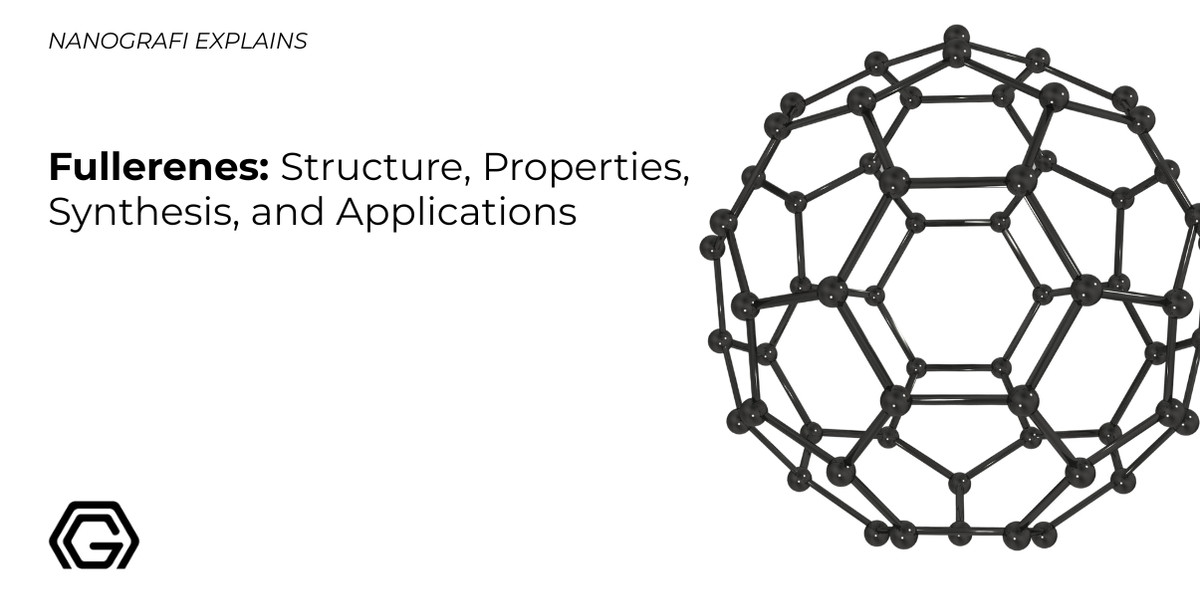
Fullerene is an allotrope of carbon whose atoms are arranged in a closed cage of pentagonal and hexagonal rings, forming hollow spheres, tubes, or ellipsoids.
The most famous fullerene is buckminsterfullerene (C₆₀), a molecule of sixty carbon atoms shaped like a soccer ball. Discovered in 1985 and recognized with the 1996 Nobel Prize in Chemistry, fullerenes expanded the known family of carbon allotropes beyond graphite and diamond and helped launch modern nanotechnology. This guide explains what fullerenes are, their structure and properties, how they are synthesized, and where they are used, with references for the key claims.
What Is Fullerene?
Fullerenes are closed-cage carbon molecules represented by the empirical formula Cₙ, in which carbon atoms bond to one another through alternating single and double bonds to form fused pentagonal and hexagonal rings. Because of their delocalized π-electrons, fullerenes show a rich and easily tunable chemistry that can be modified through standard organic reactions.
The best-known member, C₆₀, is named buckminsterfullerene after the American architect and systems theorist Richard Buckminster Fuller, whose geodesic domes share its geometry. Its common nickname, "buckyball," comes from its resemblance to a soccer ball (American Chemical Society, Discovery of Fullerenes). Fullerenes sit within the broader carbon-allotrope family alongside graphene and carbon nanotubes, which are themselves structurally related to the fullerene cage.
The Discovery and History of Fullerenes
Fullerenes were discovered in 1985 by Harold Kroto, Robert Curl, and Richard Smalley, working with graduate students James Heath and Sean O'Brien at Rice University. Using a laser to vaporize graphite in a helium atmosphere, they observed a dominant peak at 720 daltons in the mass spectrum, corresponding to a sixty-atom carbon cluster of unusual stability, and proposed a truncated-icosahedron cage structure (Nobel Prize in Chemistry 1996, nobelprize.org).
The discovery was initially met with both criticism and enthusiasm, because a single mass-spectrum peak did not prove a new allotrope. Full acceptance came in 1990, when Wolfgang Krätschmer and Donald Huffman developed an arc-discharge method that produced gram-scale quantities of C₆₀, turning a laboratory curiosity into a global research field. Kroto, Curl, and Smalley received the 1996 Nobel Prize in Chemistry for the discovery, and C₆₀ has since been detected in interstellar space, including in proto-planetary nebulae. The work also paved the way for the later isolation of carbon nanotubes in 1991 and graphene in 2004.
What Is the Structure of a Fullerene?
C₆₀ is a truncated icosahedron, a polyhedron with 32 faces made up of 20 hexagons and 12 pentagons, with a carbon atom at each of the 60 vertices and a diameter of roughly 0.7 nanometers. This arrangement gives the molecule icosahedral symmetry, one of the highest possible for any molecule, which is why carbon-13 NMR shows a single peak: all sixty carbon atoms are chemically equivalent.
A defining rule of fullerene geometry is that every closed carbon cage of this type contains exactly 12 pentagons, while the number of hexagons varies with cage size. Larger fullerenes such as C₇₀, C₇₆, and C₈₄ follow the same principle with more hexagonal faces. In the solid state, C₆₀ molecules pack into a face-centered cubic lattice, and some fullerenes are chiral owing to their lower symmetry, which makes them useful as sensors that can distinguish between enantiomers.
What Are the Properties of Fullerenes?
Electronic Behavior and Superconductivity
Pure fullerenes are electrical insulators, but doping changes this dramatically. When C₆₀ is intercalated with alkali metals to form compounds such as K₃C₆₀, it becomes a superconductor, with potassium-doped C₆₀ showing a transition temperature of 19.3 K and rubidium-doped Rb₃C₆₀ reaching about 28 K. This electronic versatility underpins much of the interest in fullerenes for electronics and energy.
Reactivity and Radical Scavenging
Fullerenes are strong electron acceptors, with abundant carbon-carbon double bonds and a low-lying lowest unoccupied molecular orbital (LUMO) that makes them highly reactive toward free radicals. This is the basis of their reputation as exceptional antioxidants: a single C₆₀ cage can absorb many radicals, and functionalized derivatives have been engineered into powerful radical scavengers. Their reactivity also enables targeted modifications, such as the Bingel reaction, that attach functional groups to tailor solubility and behavior.
Solubility and Functionalization
In their pristine form, fullerenes dissolve only in non-polar solvents, which long limited their use in biology. To overcome this, water-soluble derivatives such as fullerols (polyhydroxylated fullerenes) and amino-fullerenes have been developed, opening the door to aqueous and biomedical applications. The differences among C₆₀, C₇₀, and fullerol derivatives are explored further in the guide on types of fullerenes and their specific uses.
How Are Fullerenes Synthesized?
Most fullerene production relies on vaporizing graphite and letting the carbon vapor condense into closed cages. The main methods include:
- Arc-discharge of graphite, the Krätschmer-Huffman method, which remains the standard route for producing macroscopic quantities of C₆₀ and C₇₀.
- Laser vaporization of graphite, the original 1985 technique, which produces only small amounts but was historically decisive.
- Resistive heating of graphite, an alternative thermal route.
- Combustion and laser irradiation of polycyclic aromatic hydrocarbons (PAHs), which build cages from molecular precursors.
After synthesis, fullerenes are separated and purified, typically by solvent extraction and chromatography, to isolate specific cage sizes. The broader market and production landscape is covered in the article on why fullerenes are a growing market.
What Are the Applications of Fullerenes?
Biomedical Applications
The most active area of fullerene research is biomedicine, where their radical-scavenging, antiviral, and drug-carrying abilities are valuable. Functionalized C₆₀ derivatives have been studied as antioxidants, antibacterial agents, and neuroprotective compounds, and water-soluble fullerenes show promise as carriers in gene and drug delivery thanks to their selectivity and biocompatibility. A comprehensive look at this field is given in the review of fullerene applications in biomedicine and the article on the application of fullerene in medicine.
A notable early example was the use of a C₆₀ cage to fit into the active site of HIV-1 protease, forming a complex that inhibits the enzyme, an effect that has guided antiviral fullerene research since. Under light in oxygen-rich environments, fullerenes can also generate singlet oxygen, a reactive species useful in photodynamic therapy for killing tumor cells and inactivating viruses.
Photovoltaics and Organic Electronics
Fullerenes are excellent electron acceptors, which makes them central to organic photovoltaics. Paired with electron-donor polymers, C₆₀ derivatives such as PCBM form the donor-acceptor heterojunctions that generate long-lived, charge-separated states in organic solar cells. They are also used in organic field-effect transistors and photodetectors, where efficient electron transport matters. This electron-accepting role connects fullerenes to the wider field of printed electronics.
Polymers and Composites
The same electronic behavior makes fullerenes useful additives in polymer science. Fullerene-based polymers are produced by attaching C₆₀ cages to backbones such as polystyrene, yielding redox-active materials with tailored mechanical and electronic properties. These composites can improve durability, conductivity, and radical resistance in the host polymer.
Energy and Emerging Uses
Beyond solar cells, fullerenes are explored in hydrogen storage, lubrication, catalysis, and superconducting materials. Their stable cage and tunable chemistry continue to attract attention in nanotechnology, where they serve as molecular building blocks. The range of uses is surveyed in the overview of applications of fullerenes.
Fullerenes at a Glance
|
Property |
Detail |
|---|---|
|
Type |
Carbon allotrope (closed cage) |
|
Most common form |
C₆₀ (buckminsterfullerene) |
|
Structure of C₆₀ |
Truncated icosahedron, 20 hexagons + 12 pentagons |
|
Diameter of C₆₀ |
~0.7 nm |
|
Discovery |
1985, Kroto, Curl, and Smalley (Rice University) |
|
Recognition |
1996 Nobel Prize in Chemistry |
|
Solid-state lattice |
Face-centered cubic |
|
Superconductivity |
K₃C₆₀ at 19.3 K; Rb₃C₆₀ at ~28 K |
|
Key behaviors |
Strong electron acceptor, radical scavenger |
Values compiled from the references cited above.
Conclusion
Fullerenes are a remarkable class of carbon allotropes whose hollow, highly symmetric cages give them a unique mix of electronic, chemical, and biological properties. From the soccer-ball geometry of C₆₀ to alkali-doped superconductors and water-soluble derivatives for medicine, fullerenes bridge fundamental chemistry and applied nanotechnology. As research in organic solar cells, drug delivery, and 2D and 1D carbon materials advances, fullerenes remain a foundational building block of the field they helped create. Explore Nanografi's range of fullerenes and C₆₀ products for research and industrial use.
References
- Royal Swedish Academy of Sciences, Press Release: The 1996 Nobel Prize in Chemistry. nobelprize.org
- American Chemical Society, "Discovery of Fullerenes," National Historic Chemical Landmark.
- Buckminsterfullerene, Wikipedia (accessed 2026).
- Stephens et al., "Structure of single-phase superconducting K₃C₆₀," Nature 351, 632 (1991).
- Nimibofa et al., "Fullerenes: Synthesis and Applications," J. Mater. Sci. Res. 7, 22 (2018).
Recent Posts
-
CNT Paste vs Silver Paste vs Carbon Paste: Which Conductive Adhesive Should You Use?
Conductive pastes quietly hold much of modern electronics together. They bond chips to substrates, d …1st Oct 2026 -
ZnO Nanoparticles in OLED and Perovskite Solar Cells
Many printed solar cells and inverted display stacks need a layer that collects electrons and passes …23rd Sep 2026 -

MXene for EMI Shielding: Materials, Mechanisms and Applications
Electromagnetic interference has become a design constraint rather than an afterthought. Densely pac …10th Sep 2026