
Reduced Graphene Oxide (rGO): Properties, Synthesis & Applications
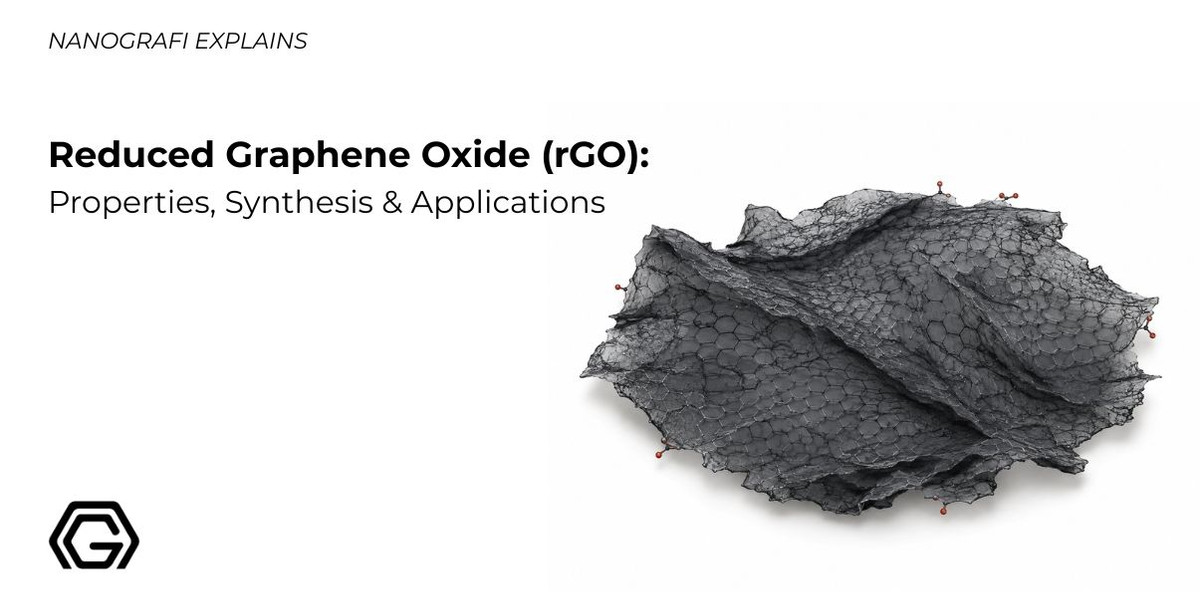
Reduced graphene oxide (rGO) is graphene oxide (GO) that has had most of its oxygen-containing functional groups, epoxide, carbonyl, carboxyl, and hydroxyl groups attached during the original oxidation of graphite, stripped back away. That single step of deoxygenation is what separates the two materials in practice: removing those oxygen groups restores much of the electrical conductivity and structural order that oxidation destroys, without requiring the far more demanding process of growing or exfoliating pristine, defect-free graphene from scratch. It is this middle ground, conductivity and mechanical performance much closer to graphene than GO, at a production cost and scalability much closer to GO than graphene, that explains why rGO has become one of the most commercially important members of the graphene family.
How rGO Differs From Graphene Oxide
The core distinction between graphene oxide and reduced graphene oxide comes down to the ratio of oxygen to carbon atoms in the structure: GO carries a high oxygen content from its oxidative synthesis, while rGO has had a large share of that oxygen removed, typically leaving an oxygen content in the range of roughly 13 to 22 percent by weight in commercially produced rGO powder, alongside a carbon content generally between 77 and 87 percent. This shift measurably changes the material's behavior rather than just its composition. GO is largely insulating because its oxygen groups disrupt the conjugated carbon network, and its rich, tunable surface chemistry is precisely why graphene oxide has become one of the most commercially significant materials in the graphene industry despite that limitation; rGO, by contrast, regains substantial electrical conductivity once its carbon network is partially restored, with commercial rGO powder commonly reported around 666.7 S/m, alongside a BET surface area typically between about 423 and 500 square meters per gram and a density near 1.91 g/cm3.
Key Properties at a Glance
| Property | Typical value |
|---|---|
| Electrical conductivity | ~666.7 S/m |
| BET surface area | ~423-500 m2/g |
| Density | ~1.91 g/cm3 |
| Oxygen content | ~13-22 wt% |
| Carbon content | ~77-87 wt% |
| Hydrogen content | ~0-1 wt% |
| Nitrogen content | ~0-1 wt% |
| Moisture content | ~3.7-4.2% |
| Appearance | Black powder |
These figures vary meaningfully between suppliers and batches, since the degree of reduction achieved during synthesis directly determines how close a given rGO sample sits to pristine graphene versus unreduced GO, which is exactly why characterization data, rather than the "rGO" label alone, should guide material selection for a specific application.
How rGO Is Synthesized
Graphene oxide is reduced back toward a graphene-like structure using one of several distinct routes, most falling into chemical, thermal, or electrochemical categories, with IR and UV irradiation also used to achieve deoxygenation without wet chemistry, a set of pathways whose reduction conditions and resulting yields are compared step by step against rGO's final electrical and structural quality:
- Chemical reduction is the most widely used commercial route, employing reducing agents such as sodium borohydride (NaBH4), hydrazine hydrate, dimethyl hydrazine, hydroquinone, hydroiodic acid, or metal powders like zinc and iron to strip oxygen groups from GO sheets in solution.
- Thermal reduction exposes GO to high temperatures, causing trapped CO and CO2 gas between the graphene layers to expand rapidly enough to exfoliate the sheets while simultaneously decomposing the oxygen-containing functional groups; even modest temperature increases can generate very large internal pressures within the stacked sheets, which is part of why thermal reduction can also improve exfoliation alongside deoxygenation.
- Electrochemical reduction applies a controlled potential to a GO-coated electrode, offering a solvent-light, more environmentally friendly path to rGO that also allows finer control over the degree of reduction achieved.
- Irradiation-based reduction uses IR or UV exposure to drive off oxygen groups without added chemical reagents, a route often favored when a cleaner reaction profile is more important than processing speed.
The choice between these methods is rarely just about cost. High-quality rGO, meaning material that more closely approaches pristine graphene in conductivity and structural order, generally requires more time-consuming, complex, or expensive processing, so production routes are usually matched to how demanding the end application actually is rather than defaulting to whichever method is fastest.
Applications
- Energy storage: rGO's high electrical conductivity, cyclic stability, and specific surface area make it a strong candidate for supercapacitor and battery electrodes, including aerogel forms of rGO developed specifically to push surface area, and therefore capacitance, even higher
- Electronics: conductive films, field-effect transistors, and other components that need a solution-processable, conductive carbon material
- Composite materials and reinforcement: rGO addition to polymers such as epoxy, PP, PE, PS, and nylon has been shown to improve tensile strength, stiffness, corrosion resistance, and abrasion resistance alongside electrical conductivity, an effect explored further where rGO is evaluated specifically for reinforcement and industry-specific use cases
- Coatings and anti-static applications: conductive and protective coatings that benefit from rGO's combination of conductivity and mechanical reinforcement
- Sensing: gas and biosensing platforms that take advantage of rGO's high conductivity and large surface area for signal transduction
- Water treatment: both GO and rGO are increasingly used in membranes and adsorbents developed for wastewater treatment, where their surface chemistry and high surface area support contaminant capture
- Biomedical applications: rGO's antibacterial characteristics and functionalizable surface support its use in emerging biomedical and drug-delivery research
Beyond Standard rGO: Functionalized Grades
Standard rGO can be further modified to add functionality that plain deoxygenation doesn't provide on its own. Grafting amine groups onto the rGO surface, as in Tetraethylene Pentamine functionalized rGO, or rGO-TEPA, improves dispersibility and reactivity for composite and adsorption applications that plain rGO handles less effectively.
Choosing the Right Grade and Format
For bulk applications such as composite reinforcement and energy storage, where large, consistent quantities matter more than ultra-fine dispersion control, Reduced Graphene Oxide at 99% purity in powder form is generally the more practical starting point, while processes where dispersing the dry powder in-house isn't practical are usually better served by a ready-to-use Reduced Graphene Oxide water dispersion. Both sit alongside the broader family of graphene oxide grades and the wider graphene product range that buyers typically compare GO, rGO, and pristine graphene formats against before committing to one.
Frequently Asked Questions
Is reduced graphene oxide the same as graphene? Not exactly. rGO retains some residual oxygen and structural defects from the reduction process, so its conductivity and mechanical properties, while much closer to graphene than GO, typically don't fully match pristine, defect-free graphene.
What is the most common way to produce rGO commercially? Chemical reduction using agents such as hydrazine hydrate or sodium borohydride is the most widely used commercial route, largely because it scales more easily than thermal or electrochemical alternatives.
Why is rGO used instead of graphene oxide in conductive applications? Because GO's oxygen-containing groups disrupt its conjugated carbon network and leave it largely insulating, while reducing that oxygen content restores much of the electrical conductivity needed for electronics, energy storage, and conductive coating applications.
Does the degree of reduction affect performance? Yes, significantly. A more thoroughly reduced sample generally shows higher conductivity and better structural order, closer to pristine graphene, which is why supplier characterization data matters more than the general "rGO" label when selecting a grade for a specific application.
References
Chua, C. K., & Pumera, M. (2014). Chemical reduction of graphene oxide: A synthetic chemistry viewpoint. Chemical Society Reviews, 43(1), 291-312.
Pei, S., & Cheng, H.-M. (2012). The reduction of graphene oxide. Carbon, 50(9), 3210-3228.
Nanografi Advanced Materials. (2026). Reduced graphene oxide (rGO), purity 99%, 2-5 layers [Product specification]. https://shop.nanografi.com/graphene/reduced-graphene-oxide-rgo-purity-99-2-5-layers/
Shin, H. J., Kim, K. K., Benayad, A., et al. (2009). Efficient reduction of graphite oxide by sodium borohydride and its effect on electrical conductance. Advanced Functional Materials, 19(12), 1987-1992.
Zhu, Y., Murali, S., Cai, W., Li, X., Suk, J. W., Potts, J. R., & Ruoff, R. S. (2010). Graphene and graphene oxide: Synthesis, properties, and applications. Advanced Materials, 22(35), 3906-3924.
Recent Posts
-
MXene for EMI Shielding: Materials, Mechanisms and Applications
Electromagnetic interference has become a design constraint rather than an afterthought. Densely pac …10th Sep 2026 -
Handling and Storage Best Practices for Metal Oxide Nanopowders
A metal oxide nanopowder is bought for a property that a coarse powder cannot deliver: a specific su …1st Sep 2026 -
Activated Carbon vs Zeolites vs MOFs: Which Adsorbent Material Should You Choose?
Activated carbon, zeolites and metal-organic frameworks (MOFs) represent three distinct adsorbent cl …20th Aug 2026