
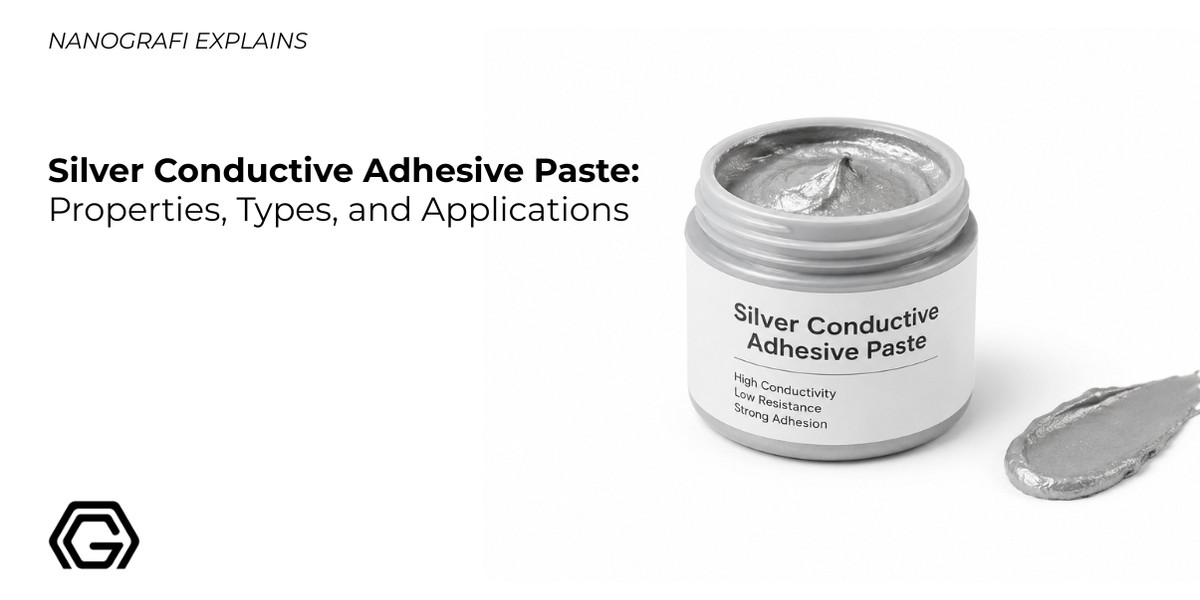
Silver Conductive Adhesive Paste: Properties, Types, and Applications
Silver conductive adhesive paste is an electrically conductive adhesive (ECA) made of silver particles dispersed in a resin binder, typically epoxy, polymer, or glass-based. Once cured, it forms a mechanically strong bond that also carries electrical current, making it a widely used alternative to soldering wherever heat-sensitive components, flexible substrates, or fine-pitch assembly are involved. Its growing role in flexible and printed electronics has made it one of the fastest-moving segments of the conductive-materials market.
How Silver Conductive Adhesives Work
Before curing, a silver paste is electrically non-conductive: the silver filler particles are suspended in the uncured resin and are not in continuous contact with each other. During curing, the resin shrinks and cross-links, forcing the silver flakes or particles into direct contact and creating continuous conductive pathways through the film. This is why curing temperature, time, and silver loading are the three parameters that most strongly determine the final resistivity, adhesion strength, and reliability of the joint. Increasing silver content generally improves conductivity, while curing conditions determine how completely that conductive network forms; under-curing can leave a paste with weak, unstable conductivity even at high silver loadings.
Types of Silver Conductive Pastes
| Type | Curing behavior | Typical strengths |
|---|---|---|
| Epoxy-based | Low-to-moderate temperature cure | Strong adhesion, good general-purpose performance |
| Polymer-based | Low temperature cure | Flexibility, compatibility with flexible and plastic substrates |
| Glass-based | High-temperature cure (firing) | Strong adhesion after high-temp processing, used in solar cell contacts |
| Nano-silver based | Fast, low-temperature cure | Shorter cure times due to small particle size, good for heat-sensitive parts |
Nanografi's Silver Paste is formulated for mild-temperature curing, around 80 degrees Celsius, which allows robust conductive bonding without stressing heat-sensitive substrates or delicate semiconductor components. This is an important consideration for flexible electronics and optoelectronic assembly, where excess heat can warp substrates or damage nearby components.
Applications
- Electronics manufacturing: a lower-stress alternative to soldering for component attachment
- Flexible electronics: bonding conductive traces on PET or polyimide films without damaging the polymer base
- EMI/RFI shielding: bonding conductive enclosures in telecommunications and aerospace assemblies
- LED and optoelectronic assembly: stable conductive and thermal paths in LED module integration
- Sensor fabrication: reliable low-resistance interconnects in sensor and instrumentation development
For related conductive-material options, see What Is Conductive Carbon Paste? and our broader overview of conductive materials and their industrial applications.
Frequently Asked Questions
Is silver conductive adhesive paste conductive before curing? No. The paste becomes conductive only after curing, when the resin shrinks and forces the silver filler particles into continuous electrical contact.
What curing temperature does silver paste typically need? It depends on the formulation. Nano-silver and polymer-based pastes can cure at relatively low temperatures, as low as about 80 degrees Celsius, while glass-based pastes require high-temperature firing.
How does silver paste compare to soldering? Silver conductive adhesive avoids the high temperatures of soldering, making it suitable for heat-sensitive components, flexible substrates, and applications where thermal stress must be minimized.
Can silver conductive adhesive replace solder in every application? Not always. Where the very highest conductivity, long-term thermal cycling resistance, or high mechanical loads are required, solder or sintered metal joints may still outperform ECAs, so the choice depends on the specific reliability requirements of the assembly.
References
- Wang, X.-Q., Gan, W.-P., Xiang, F. et al., "Effect of curing agent and curing substrate on low temperature curable silver conductive adhesive," Journal of Materials Science: Materials in Electronics, 30, 2829-2836, 2019. https://doi.org/10.1007/s10854-018-0559-y
- "Investigation of properties and curing process of silver paste electrically conductive adhesives (ECAs)," IEEE Conference Publication, 2017. https://ieeexplore.ieee.org/document/8046454/
- "Recent advances in silver-based epoxy conductive adhesive: A review," ScienceDirect, 2025. https://www.sciencedirect.com/science/article/abs/pii/S0300944025005521
- "Overcoming the trade-off between curing temperature and conductivity for high-performance conductive silver pastes," Frontiers of Materials Science, 2025. https://link.springer.com/article/10.1007/s11706-025-0733-0
- "A Comparison of Silver Conductive Pastes: Types, Properties, and Performance," Techinstro Blog, 2023. https://blog.techinstro.com/a-comparison-of-silver-conductive-pastes-types-properties-and-performance/
Recent Posts
-
Handling and Storage Best Practices for Metal Oxide Nanopowders
A metal oxide nanopowder is bought for a property that a coarse powder cannot deliver: a specific su …1st Sep 2026 -
Activated Carbon vs Zeolites vs MOFs: Which Adsorbent Material Should You Choose?
Activated carbon, zeolites and metal-organic frameworks (MOFs) represent three distinct adsorbent cl …20th Aug 2026 -

Anti-Icing Nanocoatings: How Nanomaterials Prevent Ice Formation on Aircraft, Wind Turbines, and Power Lines
Ice accretion is not a cosmetic problem for industrial equipment operating in cold climates. On airc …12th Aug 2026